Pokemon Move Categories: Physical, Special, Status, and More
Pokemon move categories tell you how a move behaves in battle: Physical, Special, or Status. They are easy to confuse with a move's type, but the two labels answer different questions. This guide shows how to read both, compare power and accuracy, understand STAB and coverage, and avoid mixing rules from different Pokemon games.
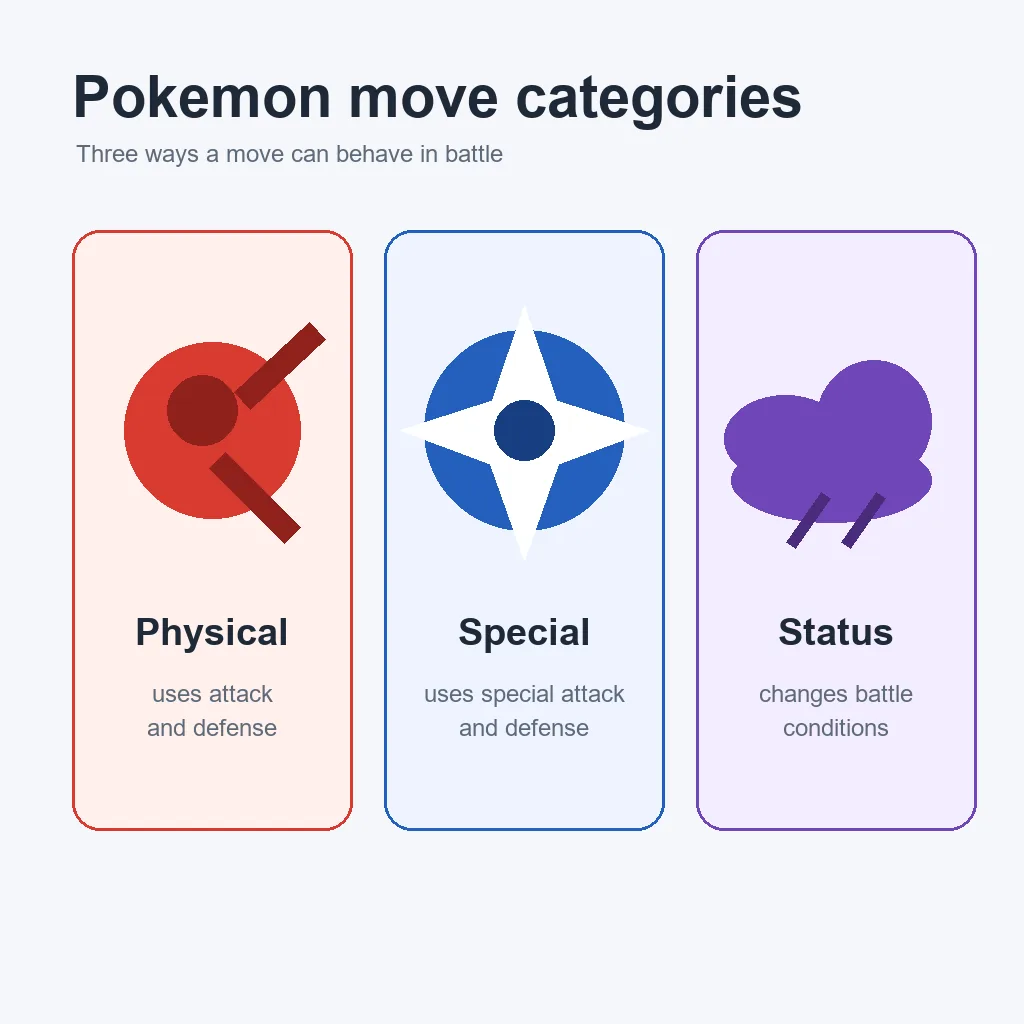
Pokemon Move Categories at a Glance
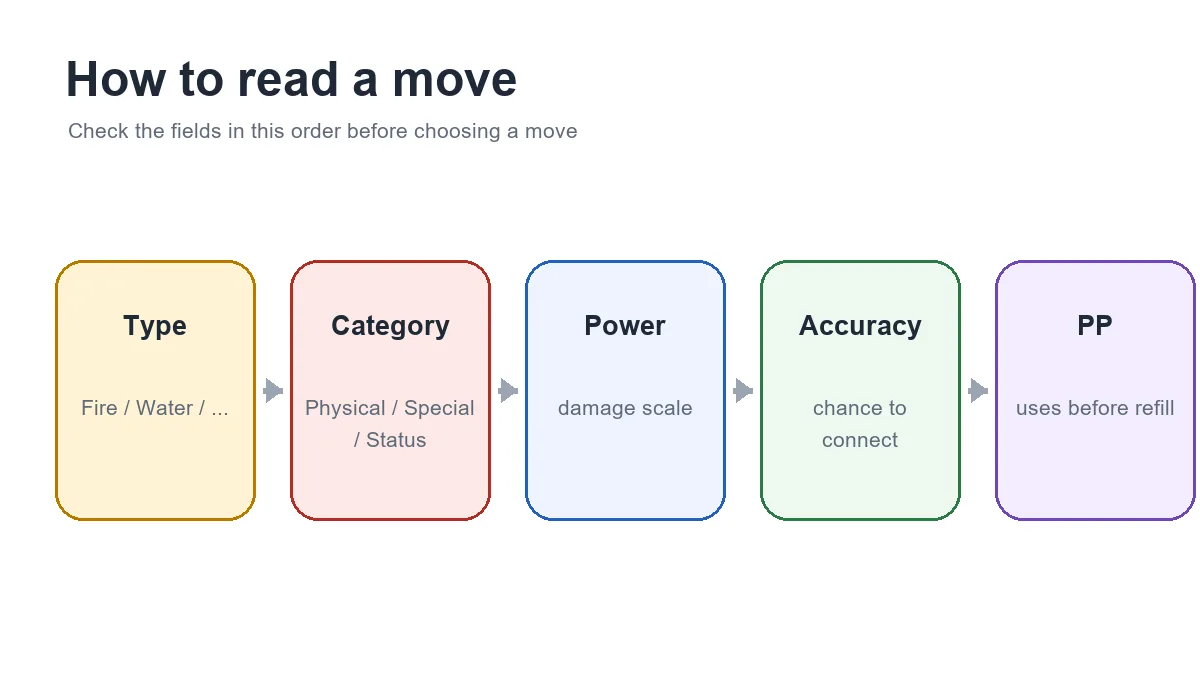
Every move entry gives you several pieces of information. Category is the battle role, type is the move's elemental label, and the remaining fields help you judge reliability and purpose. The three categories below are the foundation for reading most move lists.
Usually deals damage through the Attack and Defense sides of the stat calculation. Contact moves are often Physical, but contact is a separate property.
Usually deals damage through Special Attack and Special Defense. A Special move can still have a physical-looking animation.
Usually creates an effect instead of direct damage: a stat change, condition, screen, recovery effect, weather change, or field setup.
| Field | What it tells you | Common mistake |
|---|---|---|
| Type | What matchup chart and STAB rules apply. | Assuming Fire type automatically means Special. |
| Category | Whether the move is Physical, Special, or Status. | Using the user's strongest stat without checking the category. |
| Power | A starting damage value for many damaging moves. | Treating higher Power as an automatic best choice. |
| Accuracy | How reliably the move can connect when accuracy rules apply. | Ignoring misses in a high-stakes battle. |
| PP | How many times the move can be used before restoration. | Forgetting that long routes and challenge rules make PP matter. |
Physical vs. Special vs. Status
Physical moves
Physical moves are the category to check when a Pokemon is built around Attack. A claw, punch, or contact animation does not prove that a move is Physical; the move data does. A Physical attack can also lower a stat or cause a condition without becoming a Status move.
Special moves
Special moves are normally the better starting point for a Pokemon that uses Special Attack. They may look like beams, waves, sound, or wind, but animation is not the rule. Compare the complete entry instead of judging from appearance alone.
Status moves
Status moves are often the most flexible category. They may lower an opponent's stats, raise an ally's stats, inflict a major condition, restore HP, set a screen, change weather, create terrain, remove hazards, or force a switch. “Status” does not mean “weak”: a move that creates a winning position can be more valuable than another attack, especially when the team already has enough damage options.
Move Type Is Not Move Category
The fastest way to avoid confusion is to treat the labels as two axes. Type answers “what kind of elemental matchup is this?” Category answers “what kind of battle behavior does this move use?” A Water move may be Physical, Special, or Status depending on the individual move. The same is true for Fire, Ghost, Dark, Fairy, and other types.
Type controls interactions such as weaknesses, resistances, immunities, and Same-Type Attack Bonus (STAB). Category helps you compare the user's offensive stat with the target's defensive stat for a damaging move. Read both fields before deciding whether a move belongs on a set. The Pokemon Type Chart is useful for matchup questions, while the Pokemon Coverage Calculator helps you think about which attacking types your choices can reach.
How to Read Power, Accuracy, and PP
Power is a starting point, not a final score
Power gives you a baseline for many damaging moves, but Ability effects, held items, STAB, critical hits, stat stages, weather, terrain, screens, defenses, and special rules can change the result. A lower-Power move with excellent accuracy or a strong effect may be the better choice. Status moves often show no ordinary Power value because their job is not direct damage.
Accuracy is a reliability decision
Accuracy tells you how often a move can connect under normal conditions. A powerful move that misses at the wrong moment can be worse for a story playthrough or a battle challenge than a slightly weaker reliable move. Some moves have an accuracy value that can be modified, while others are listed as guaranteed to hit in particular situations. Read the move's notes and the game's rules rather than assuming every “—” entry means the same thing.
PP matters outside a single battle
PP is the move's usage budget. In a short battle, it may never matter. Across a long route, dungeon, challenge run, or resource-limited format, it can influence whether a set is comfortable to use. PP Up, PP Max, move-restoring items, and the way a game handles healing all differ, so treat PP as a practical constraint instead of a permanent universal number.
How to Choose Moves for a Pokemon
Start with the role you want the Pokemon to play. An attacking set often wants a reliable STAB move, one coverage option, and utility. A support Pokemon may prioritize recovery, speed control, screens, hazards, or a condition. The best answer depends on the game, available moves, team partners, and format.
- Check the useful attacking stat. If Attack is clearly stronger, begin with Physical candidates; if Special Attack is stronger, begin with Special candidates. Do not ignore abilities or unusual move effects.
- Check the type relationship. Choose at least one move that benefits from the Pokemon's type when that fits the role, then add coverage for targets the team struggles to pressure.
- Compare reliability. Put Power, Accuracy, PP, priority, recoil, charging turns, and secondary effects on the same checklist.
- Check the actual game. A move may be unavailable, have a different tutor or TM source, or work differently in a remake, spin-off, or special battle mode.
If the question is defensive rather than offensive, move choice is only part of the answer. Use the Pokemon Weakness Calculator to review team matchup gaps, and read the Pokemon Abilities Guide when an Ability changes how a move or type interaction behaves.
How Pokemon Learn Moves
Move availability is game-specific. Common routes include leveling up, TMs or equivalent items, move tutors, breeding or Egg Moves, evolution, reminders, and special events. A database entry does not prove that a move is available in your exact title or save file, so check the game's learnset before planning around it.
Generation and Game Differences
The most important historical boundary is the Physical/Special split. In Generations I through III, a move's type determined whether a damaging move behaved as Physical or Special. From Generation IV onward, the category is assigned to the individual move, which allows one type to contain both Physical and Special attacks. Later games can still adjust move power, accuracy, effects, availability, and formulas.
That is why a broad “best moves” answer can mislead. A casual playthrough may value accuracy and PP, while a format may depend on speed control, team structure, abilities, items, and the current ruleset. Understand the fields here, then verify the exact move entry.
Pokemon Move Categories FAQ
What are the categories of Pokemon moves?
The three core Pokemon move categories are Physical, Special, and Status. Physical and Special are usually damaging categories with different stat interactions; Status moves focus on effects, setup, recovery, field changes, or conditions.
Is a Fire move always Special?
No. Type and category are separate. Fire moves can be Physical, Special, or Status, and the same principle applies to every other type. Check the individual move entry rather than guessing from the type name.
What is the difference between Physical and Special damage?
In modern core-series rules, Physical damage usually compares the user's Attack with the target's Defense, while Special damage usually compares Special Attack with Special Defense. Abilities, moves, items, stages, and game-specific rules can modify the result.
Do Status moves ever deal damage?
The Status category is normally used for moves whose main job is an effect rather than direct damage. Some effects can cause damage over time or create indirect damage, so read the move's full description instead of treating the category as a promise that nothing can happen to HP.
Why do older Pokemon games seem to classify moves differently?
Before the Generation IV Physical/Special split, the move's type determined the Physical or Special side for damaging moves. Modern games classify moves individually, so an old guide and a current move list may describe the same type differently.
Where can I check a complete Pokemon move list?
Use a game-specific move database for exhaustive entries, then use this guide to interpret the fields. The Pokemon Database move list, Bulbapedia move category references, and the official Pokemon Pokedex are useful starting points, but always check the exact game column.
Summary
Pokemon move categories are the first filter for understanding a move: Physical, Special, or Status. Next, separate type from category, compare Power, Accuracy, and PP, and consider STAB, coverage, utility, and the exact game. Once you read those fields together, move lists become much easier to use—and you can make a moveset that fits the Pokemon, the team, and the way you actually play.