Pokemon Moves List: Types, Categories, and Examples
Pokemon moves list searches usually need a fast index and a clear explanation of what each move does. This guide groups representative moves by type, separates Physical, Special, and Status categories, and explains the fields that matter for a Pokemon or team. It is a practical index, not a replacement for a game-specific database.
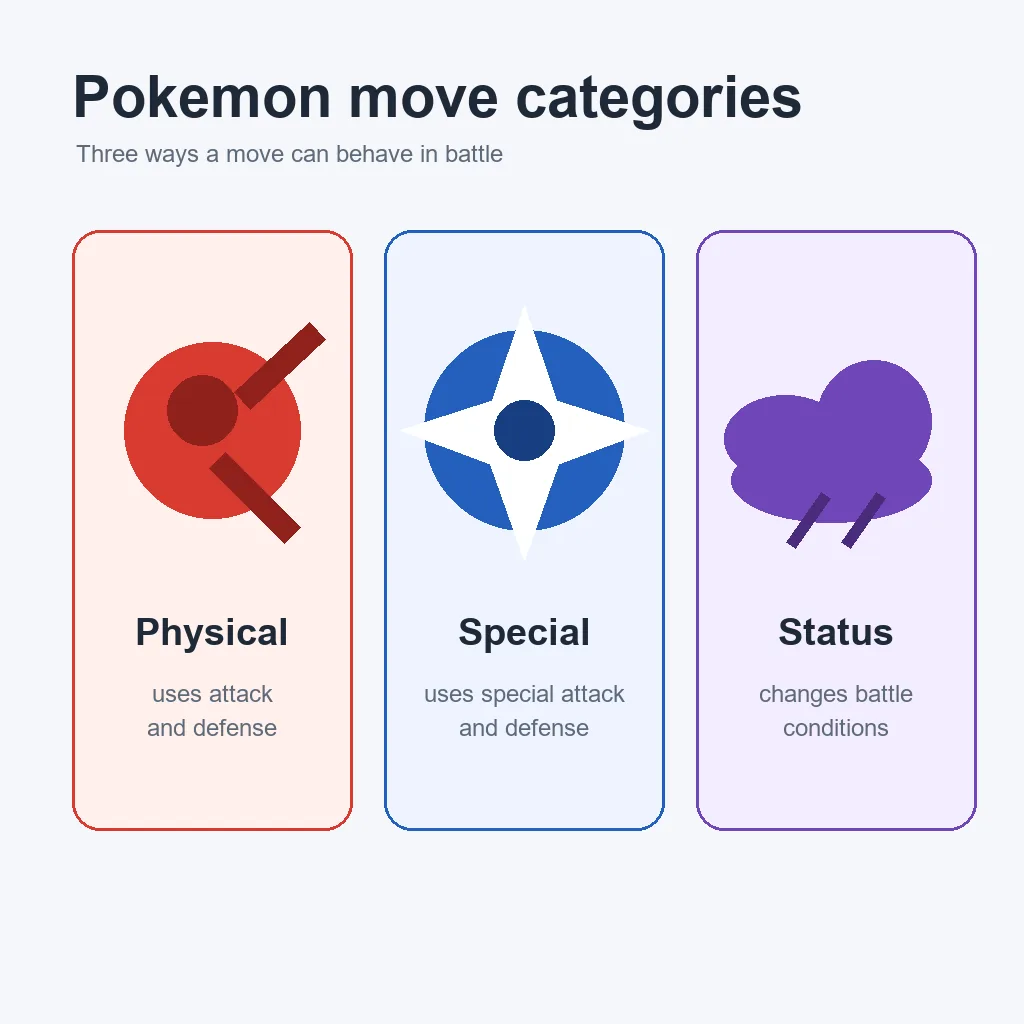
Pokemon Moves List at a Glance
Use a move list as a set of filters. Type narrows the matchup, category shows the offensive or support role, and the remaining fields reveal the trade-off.
| Category or field | What it tells you | Good question to ask |
|---|---|---|
| Physical | Usually uses Attack against Defense for direct damage. | Does this Pokemon have the Attack and contact safety to use it? |
| Special | Usually uses Special Attack against Special Defense for direct damage. | Does the user get more value from a special stat or effect? |
| Status | Focuses on conditions, boosts, recovery, hazards, weather, or terrain. | Does the team need a position-changing effect instead of another attack? |
| Power | A starting damage value for many damaging moves. | What accuracy, recoil, charge turn, or effect comes with that power? |
| Accuracy | How reliably a move connects under the game's normal rules. | Can one miss cost the battle or the challenge run? |
| PP | How many uses are available before restoring the move. | Will this set survive a long route, dungeon, or limited format? |
Scope note: The examples below are familiar reference points, not an exhaustive list of every move. Use them to orient yourself, then verify the exact move entry and learn method in your game.
Pokemon Moves by Type
This Pokemon moves list uses the standard 18 type names from the core-series battle system. One type can contain Physical, Special, and Status moves, so a type label alone does not tell you how damage works. Use the linked tools for matchup or team checks.
| Type | Representative move examples | Typical use or reminder |
|---|---|---|
| Normal | Tackle, Hyper Beam, Protect | Broad neutral coverage and many utility moves; the type has no attacking weakness bonus in the standard chart. |
| Fire | Flamethrower, Flare Blitz, Will-O-Wisp | Strong offensive coverage plus burn utility; check whether the user prefers Special or Physical damage. |
| Water | Surf, Liquidation, Aqua Ring | Reliable coverage and flexible support; Water moves appear in all three categories. |
| Electric | Thunderbolt, Wild Charge, Thunder Wave | Useful against Water and Flying targets; remember that Ground immunity changes the matchup. |
| Grass | Energy Ball, Leaf Blade, Leech Seed | Often trades raw power for draining, seed, weather, or other sustained effects. |
| Ice | Ice Beam, Icicle Crash, Ice Shard | Valuable coverage and priority options, but defensive Ice weaknesses make the return matchup important. |
| Fighting | Close Combat, Drain Punch, Bulk Up | Pressures Normal, Rock, Steel, Ice, and Dark targets; check defense drops and setup turns. |
| Poison | Sludge Bomb, Poison Jab, Toxic | Poisoning and anti-Fairy coverage are common reasons to carry this type. |
| Ground | Earthquake, Earth Power, Stealth Rock | Strong physical and special coverage plus hazards; Flying and Levitate-style immunities matter. |
| Flying | Brave Bird, Air Slash, Roost | Can provide speed pressure, flinch chances, or recovery; watch for Rock and Electric responses. |
| Psychic | Psychic, Psyshock, Trick Room | Special pressure, a defense-targeting option, and speed-control utility cover different team needs. |
| Bug | U-turn, Bug Buzz, Sticky Web | U-turn creates momentum while Sticky Web changes the speed context for the whole team. |
| Rock | Stone Edge, Rock Slide, Stealth Rock | Useful against Flying, Fire, Ice, and Bug; accuracy and hazard timing are common trade-offs. |
| Ghost | Shadow Ball, Shadow Sneak, Will-O-Wisp | Ghost immunity and Normal interaction can make the matchup less obvious than the move name suggests. |
| Dragon | Dragon Claw, Draco Meteor, Dragon Dance | Often rewards careful target selection because Fairy immunity and Steel resistance can stop a sweep. |
| Dark | Knock Off, Dark Pulse, Taunt | Item removal, flinches, and anti-Psychic pressure give this type several roles beyond damage. |
| Steel | Iron Head, Flash Cannon, Swords Dance | Strong defensive identity and setup options; check whether the move is contact-based or special. |
| Fairy | Moonblast, Play Rough, Misty Terrain | Important Dragon counterplay with both offensive and field-support options. |
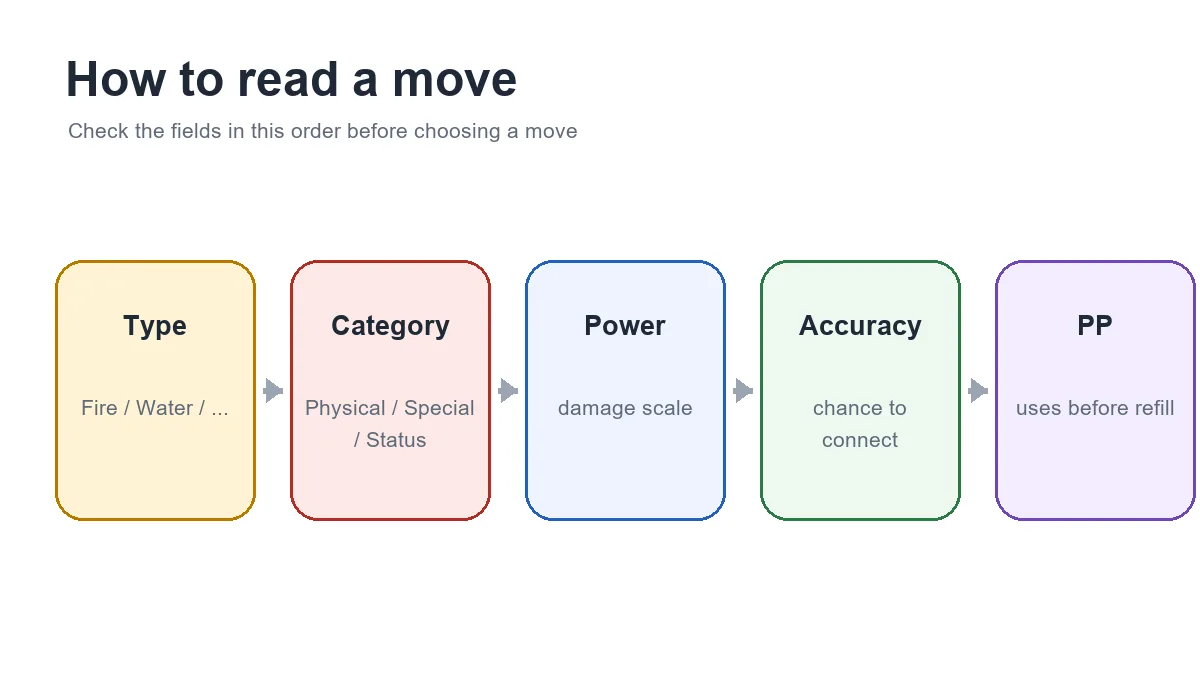
How to Read Move Details
Type and category answer different questions
Type answers, "What matchup does this move create?" It controls weaknesses, resistances, immunities, and Same-Type Attack Bonus (STAB). Category answers, "What battle behavior does this move use?" In modern core-series games, a damaging Physical move usually compares Attack with Defense, while a Special move usually compares Special Attack with Special Defense. Status moves usually spend their value on an effect rather than direct damage.
This separation is why a Water move is not automatically Special and a Fire move is not automatically Physical. The individual entry decides. The Pokemon Move Categories guide explains the historical Physical/Special split, while the Pokemon Type Chart is the faster reference for matchup multipliers.
Power, accuracy, and PP are a practical triangle
Power is a useful starting number, not a final damage forecast. STAB, abilities, items, critical hits, stat stages, weather, terrain, screens, target defenses, and special formulas can all change the outcome. Accuracy is a reliability decision: a lower-power move that connects consistently may outperform a stronger move in a long fight. PP is the usage budget, which matters much more on routes, challenge runs, and formats with limited healing than in one short battle.
Secondary effects can change the best answer
Priority, recoil, charging turns, flinches, stat drops, status conditions, healing, item removal, hazards, and switching effects often matter more than a small Power difference. Read the complete description before calling one move "best." The right choice depends on the Pokemon's role, the team around it, and the game's rules.
How to Choose a Move for Your Pokemon
Use this short process when a long move list gives you too many options:
- Define the role. Decide whether the Pokemon is attacking, supporting, setting hazards, controlling speed, or creating momentum.
- Match the category to the useful stat. Start with Physical moves for a clear Attack user and Special moves for a clear Special Attack user, then check abilities and unusual effects.
- Keep at least one reliable STAB option. A same-type move often gives dependable pressure, but do not force STAB when a support move solves the team's actual problem.
- Cover the team's targets. Use a Pokemon Coverage Calculator to see which types your attacks can reach and a Pokemon Weakness Calculator to review defensive gaps.
- Check the exact game. Confirm the move is available by level, TM, tutor, breeding, evolution, or event, and verify its current Power, Accuracy, PP, and effect.
Complete List vs Game-Specific Data
There is no permanent "all Pokemon moves" answer for every title. The roster grows, and a remake, DLC pack, battle facility, or spin-off can change the available pool. Power, accuracy, PP, effects, learn methods, and categories may also differ.
For an exhaustive lookup, use a game-specific database such as the Pokemon Database Attackdex, cross-check names and historical notes with Bulbapedia's move references, and use the official Pokemon Pokedex for first-party Pokemon context. Those sources are better for a complete, title-specific table than a static evergreen article.
Pokemon Moves List FAQ
Where can I find a complete Pokemon moves list?
Use a game-specific move database for the complete set of entries, then use this page as a quick index of types, categories, and important fields. Availability changes by game, generation, form, and format.
How many Pokemon moves are there?
The count depends on the generation and ruleset. New releases add moves, while remakes and spin-offs may remove or alter availability, so a single permanent number is not reliable.
What are the three Pokemon move categories?
The three core categories are Physical, Special, and Status. Physical and Special usually deal direct damage through different stat pairs, while Status moves focus on effects, setup, recovery, or field changes.
Is Pokemon move type the same as category?
No. Type describes the elemental matchup, such as Fire or Water. Category describes whether the move is Physical, Special, or Status. One type can contain moves from all three categories.
Why does a move list show different power or availability?
Power, accuracy, PP, effects, learn methods, and the move roster can change between generations, remakes, DLC, and spin-offs. Always check the column for the exact game you are playing.
How do I choose a move for my Pokemon team?
Start with the Pokemon's role and useful attacking stat, then compare type coverage, category, reliability, PP, priority, and secondary effects. Use a weakness or coverage calculator when you need to check the whole team.
Summary
This Pokemon moves list makes a large move pool easier to scan. Start with type, separate category from type, compare Power, Accuracy, and PP, then read the effect and availability notes. When the exact game matters, verify the entry before building a set.
Sources and verification
- Pokemon Database Attackdex for searchable move entries and game-specific columns.
- Bulbapedia move references for historical names, categories, and availability notes.
- Official Pokemon Pokedex for first-party Pokemon and type context.