Pokemon Status Effects: Burn, Sleep, Paralysis, Poison & More
Pokemon status effects are battle conditions that change what a Pokemon can do, how much damage it takes, or what happens between turns. The quickest way to understand them is to separate major status conditions such as burn, poison, paralysis, sleep, and freeze from volatile effects such as confusion, flinching, trapping, and infatuation.
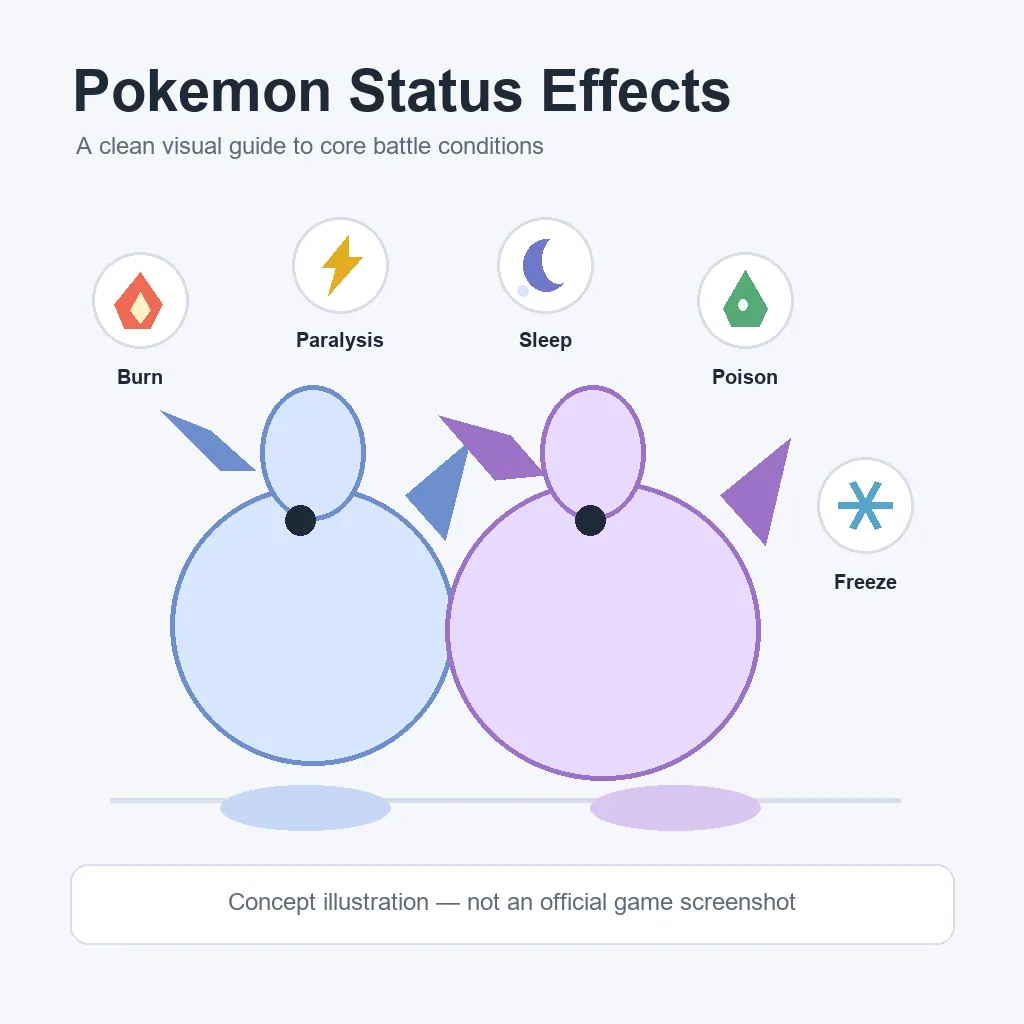
What are Pokemon status effects?
A status effect is a condition applied by a move, Ability, item, field effect, or other battle event. Unlike a normal damage number, the condition changes future turns. It may reduce a stat, prevent an action, add damage at the end of a turn, or create a chance that an attack fails. That makes status effects useful even when the move that applies them does little direct damage.
People often use “status” to describe every temporary battle problem, but the game systems are more precise. A major condition is usually shown as a persistent status in the Pokemon's summary or battle state. A volatile effect is attached to the current battle and may disappear after a timer, a switch, a faint, or a specific trigger. The categories are helpful for learning, but they are not permission to ignore a particular game's wording.
Major status conditions at a glance
The table below uses the common core-series vocabulary. It describes the practical battle idea, not a complete list of every move, formula, or special mode. “Common check” is the question to ask before assuming the condition will work.
| Condition | Category | Typical impact | Common check |
|---|---|---|---|
| Burn | Major | Deals recurring damage and commonly weakens physical damage in the core games. | Check the target's type, Ability, move category, and game generation. |
| Poison | Major | Deals recurring damage after turns or at a defined battle interval. | Check poison immunity, cure items, and whether the move applies regular or badly poisoned. |
| Badly poisoned | Major | Uses an escalating damage pattern in many core-series battles. | Do not treat it as identical to ordinary poison; switching and game rules can affect the counter. |
| Paralysis | Major | Usually reduces Speed and may prevent the Pokemon from acting on a turn. | Check generation-specific Speed rules and whether the target is protected by type or Ability. |
| Sleep | Major | Usually prevents normal actions for a limited duration, although the exact duration varies. | Check sleep-turn rules, wake-up moves, and whether the game uses a different sleep model. |
| Freeze | Major | Usually prevents normal actions until the Pokemon thaws or is cured. | Check thawing moves, items, type interactions, and alternate game terminology. |
Major vs. volatile effects
The split asks whether a condition belongs to the Pokemon beyond the current exchange or is only a temporary battle modifier. Burn and poison are common major conditions; confusion, infatuation, flinch, trapping, Leech Seed, and similar effects are generally volatile. A Pokemon can often have one major condition plus volatile effects, subject to game-specific limits.
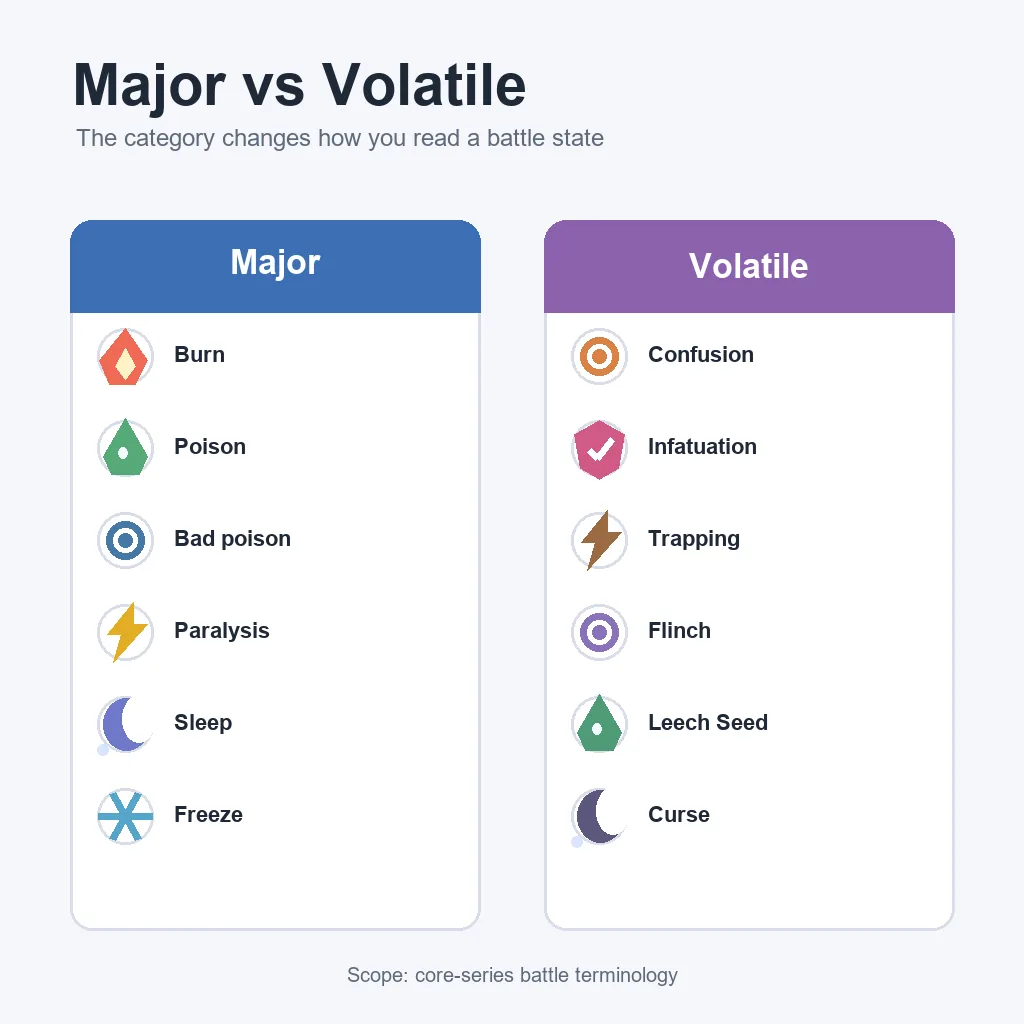
Confusion is the common source of misunderstanding. It can interfere with an action for a short time, but it is not the same record as burn, poison, or paralysis. Flinch is shorter still, while trapping can restrict switching without becoming a permanent major condition.
When a move says it causes or cures “status,” check the game's wording. A cure may target only a major condition, only a volatile effect, or the whole battle state.
What each condition does
Burn: pressure on physical attackers
Burn combines recurring damage with a physical-offense penalty in many core-series contexts, so it is especially relevant against a physical attacker. It is not a complete shutdown: special attacks, Abilities, items, and switching plans can keep a burned Pokemon useful. Pair this guide with the site's Pokemon Weakness Calculator instead of treating burn as another type weakness.
Poison and badly poisoned: steady damage with different pacing
Regular poison creates predictable recurring damage. Badly poisoned commonly becomes more threatening as the battle continues, so do not collapse both into one label. Type, Ability, item, field, and generation can change whether the effect lands and how its counter behaves.
Paralysis: speed and action reliability
Paralysis usually means a slower target plus a chance that the target cannot act. That balance has changed across generations, so old guides can mislead. In a casual team it can open a turn for a slower favorite; in a precise calculation, the Speed stage and turn order matter most.
Sleep and freeze: strong control with strict boundaries
Sleep and freeze can prevent normal actions, so their duration and cure rules matter as much as their names. Items, moves, Abilities, and game-specific rules can shorten or prevent them. Alternate battle systems may use a different name or timing model.
Confusion, flinch, and other volatile effects
Volatile effects usually belong to the current battle sequence. Confusion, flinch, infatuation, trapping, Leech Seed, and curse-like effects differ in duration and removal. Ask whether switching ends the effect and whether it can coexist with a major condition.
How to read a status effect in battle
When a move or Ability applies a condition, use four checks. Identify the trigger, then ask whether the target can receive it. Type immunities and Abilities often matter before damage is calculated.
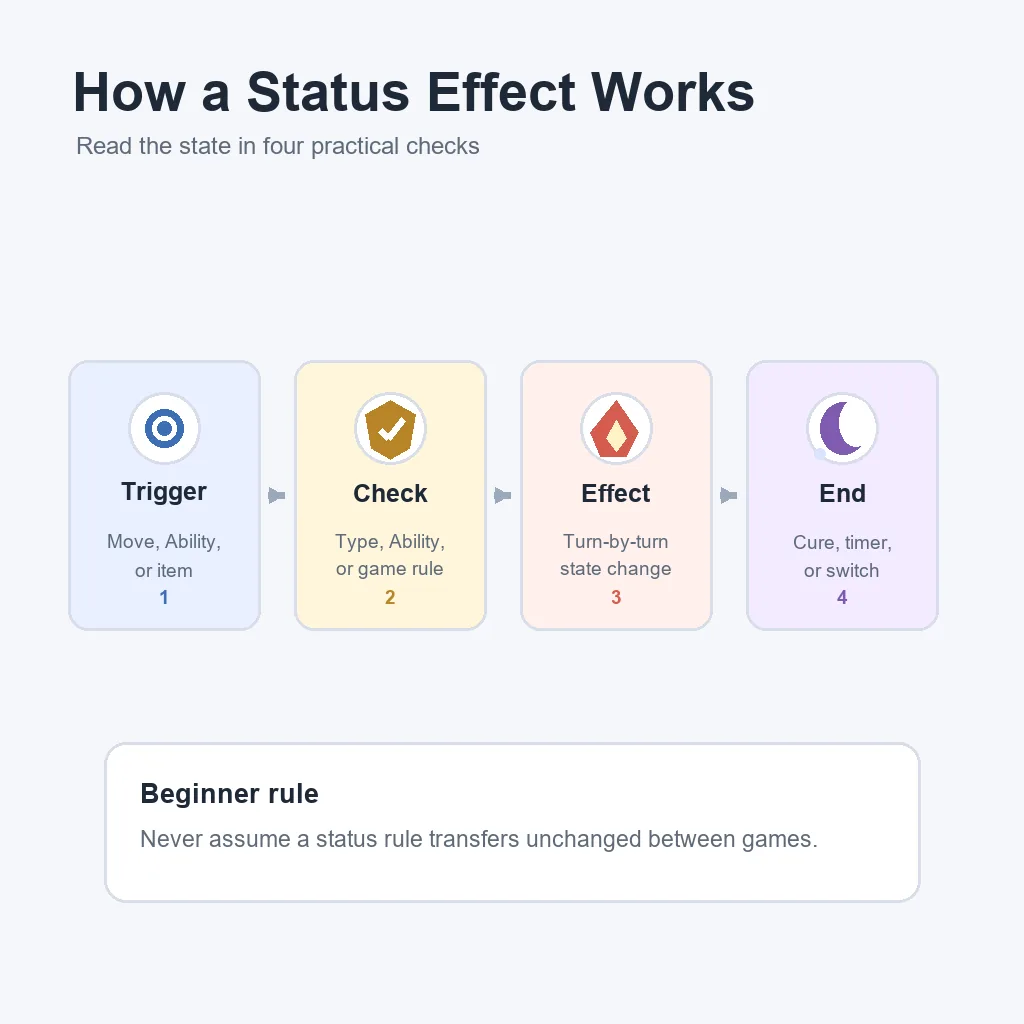
- Trigger: identify the move, Ability, item, or field event that starts the condition.
- Eligibility: check type, Ability, item, form, terrain, weather, and game-specific restrictions.
- Effect: note whether the condition changes damage, Speed, action reliability, switching, or the end-of-turn sequence.
- End: find the cure, timer, switch rule, faint rule, or scripted event that removes it.
Cures, immunities, and common mistakes
Cure items are the simplest answer for major conditions. Antidote, Paralyze Heal, Awakening, Burn Heal, Ice Heal, and Full Heal are familiar examples, but the item list depends on the game. Berries, moves, Abilities, rest mechanics, switching, field effects, and automatic end-of-battle rules can also matter. Volatile effects may disappear when their trigger ends or when the Pokemon switches; a major condition often remains until explicitly removed.
Immunity is broader than type alone. A target may be protected by a type, Ability, held item, terrain, status already present, or a rule in a particular format. Some effects also have a difference between “cannot be inflicted” and “can be removed after it exists.” If a move fails, read the battle message and check the target's Ability before assuming the move is inaccurate.
Game boundaries and the Pokemon TCG
This page uses the core-series video-game idea of Pokemon status effects. Spin-offs, mobile games, battle facilities, and fan formats may rename a condition, change its formula, or use a different turn sequence.
The Pokemon Trading Card Game is a separate system. It uses Special Conditions such as Asleep, Burned, Confused, Paralyzed, and Poisoned, but cards resolve those conditions through card turns, coin flips, markers, and retreat rules. A player searching for TCG rules should use a TCG-specific reference, not copy the video-game table above.
For release-era context, use the site's Pokemon generations list; for a quick review of related battle facts, try Pokemon Trivia. This page is an orientation guide, not an exhaustive move database.
Pokemon status effects FAQ
What are the main Pokemon status effects?
The common major conditions are burn, poison, badly poisoned, paralysis, sleep, and freeze. Volatile effects include confusion, flinch, infatuation, trapping, Leech Seed, and other battle modifiers that usually have their own duration or removal rule.
Is confusion a major status condition in Pokemon?
Usually no. Confusion is generally volatile because it lasts for a limited period and can end without replacing a major condition such as burn or poison.
Does switching cure a Pokemon status effect?
Switching often ends volatile effects, but a major condition commonly remains. Trapping, abilities, moves, and game-specific rules can change the result, so read the exact title's battle behavior.
Can a Pokemon be immune to a status effect?
Yes. Type rules, Abilities, held items, field effects, and special battle rules can block a condition. A move's accuracy does not override an immunity.
Are Pokemon video game and TCG status effects the same?
No. The TCG uses its own Special Conditions and card-turn procedures. This guide covers core-series video-game mechanics and only mentions the TCG to mark that boundary.
Which Pokemon status effect is best?
There is no universal best condition. Match the effect to the target and the plan: damage-over-time conditions, action control, Speed disruption, and switching pressure each solve a different problem.
Summary
Read Pokemon status effects as battle states, not a flat power ranking. Separate major from volatile effects, then check the trigger, eligibility, turn-by-turn impact, and removal rule. Burn, poison, paralysis, sleep, and freeze can shape a fight; confusion, flinch, trapping, and related effects manage shorter windows. Verify the game's local rule before making a team or move decision.
Sources and verification
- Bulbapedia: Status condition — terminology and game-specific cross-check.
- Serebii: Status Effects — compact reference for common battle behavior.
- Pokémon Database: Status Conditions — quick reference for names and effects.