What Are EVs and IVs in Pokemon? A Practical Guide
What are EVs and IVs in Pokemon? IVs describe a Pokemon's built-in stat potential, while EVs describe the effort it has accumulated through training. They both affect the final numbers on a stat screen, but they are not the same thing. This guide separates EVs, IVs, base stats, Nature, and battle choices so you can build a team without mixing up the terms.
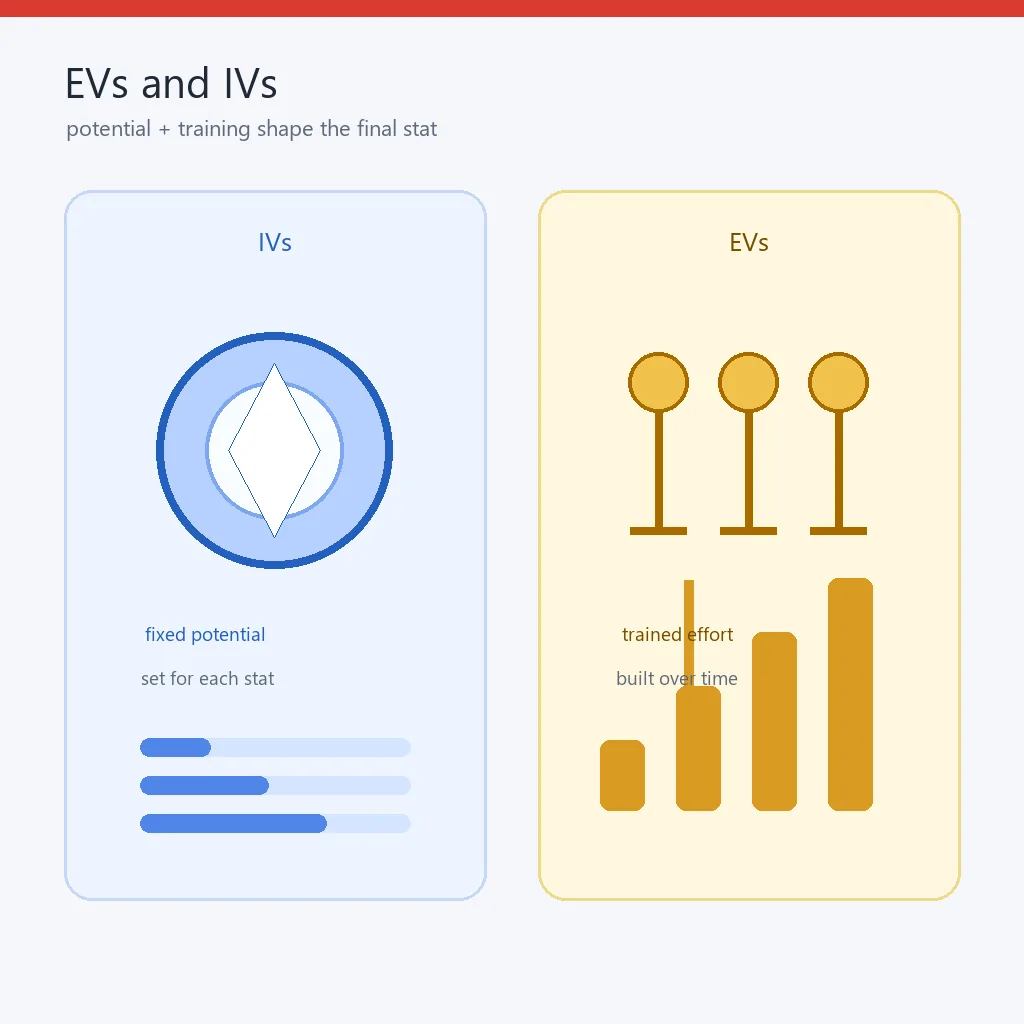
What are EVs and IVs in Pokemon?
The easiest distinction is potential versus training. An IV is part of the individual Pokemon's starting data for a stat. An EV is a point in the training record that you direct toward a stat. A Pokemon with strong Speed IV potential can still have a poorly planned Speed spread, while a Pokemon with a useful role can perform well without perfect values if its training matches the job.
Species base stats set the broad shape, while level, Nature, Abilities, moves, items, and battle rules change the result. Use EVs and IVs as two parts of a build, not the whole build.
The species-level template: HP, Attack, Defense, Special Attack, Special Defense, and Speed start from here.
Individual potential attached to a Pokemon. In modern core games, each stat is commonly discussed on a 0–31 scale.
Training effort earned and allocated across stats. A spread is a decision about role, not a universal “more is better” button.
What IVs mean
Individual Values are hidden or partially hidden values that help distinguish one Pokemon from another of the same species. The six familiar stat categories are HP, Attack, Defense, Special Attack, Special Defense, and Speed. In the modern core-series shorthand, a higher IV means more built-in potential for that stat than a lower IV at the same level and under the same other conditions.
IVs are a starting property, not a training route. A game may reveal them through a judge or appraisal feature, generate them through an encounter or breeding system, or provide a way to make a stat function as if it had a high IV. These systems are title-specific, so verify the game before spending rare resources.
A perfect IV is not automatically useful. An attacker may value offensive and Speed IVs, while a special build may not care about Attack and a narrow support strategy may prefer lower Speed. Ask whether the value helps the role you are building.
What EVs mean
Effort Values represent accumulated training. Depending on the game, they can come from battles, items, vitamins, feathers, activities, or other systems. The key idea is allocation: adding more to one stat leaves less room elsewhere when the budget is limited.
The modern core-series model uses 510 EVs total and 252 in one stat. A 252 / 252 / 4 spread is a starting point; defensive builds may differ.
EVs do not always appear as a one-for-one screen change. Level, formulas, rounding, Nature, and game version affect when a point becomes visible. “I added four EVs, so the stat must rise by one” is not a universal rule; verify the spread in the specific title or calculator.
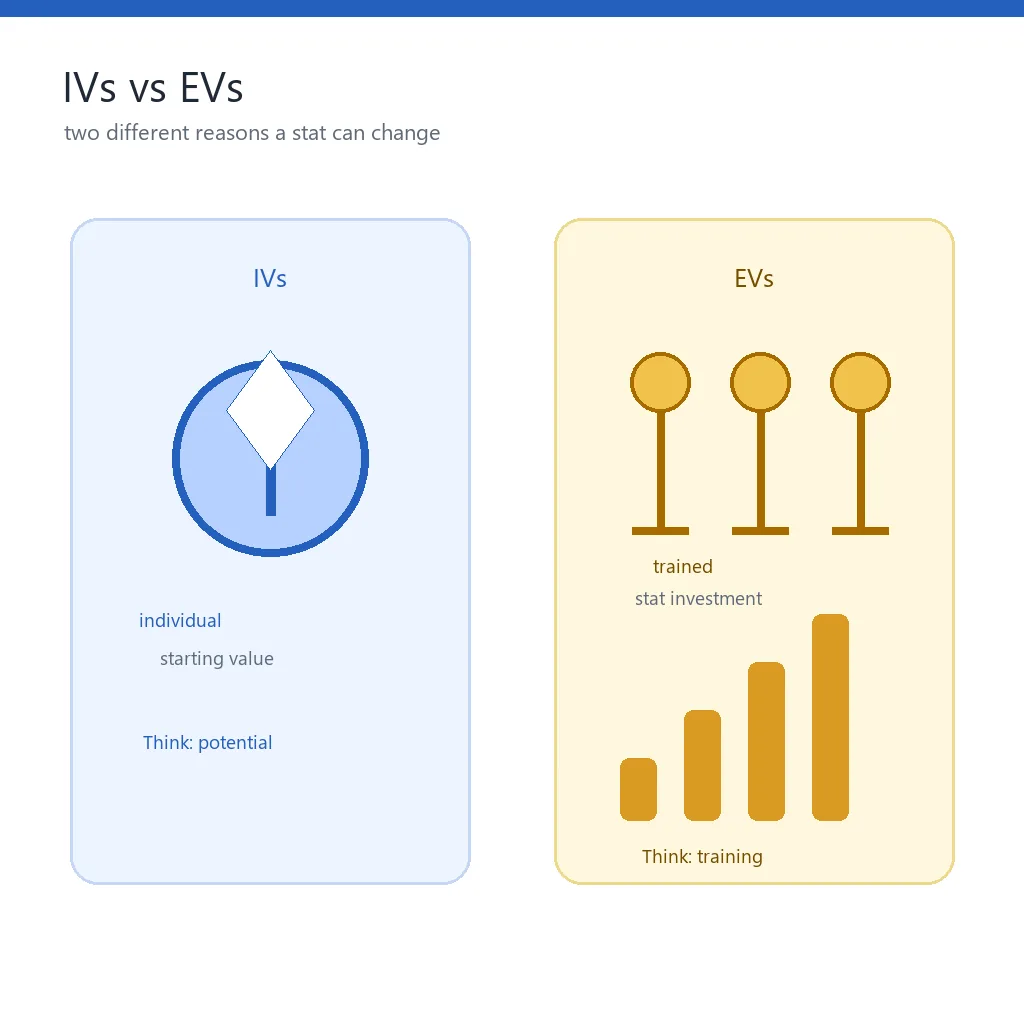
How EVs, IVs, base stats, and Nature fit together
Think of a final stat as several layers: the species supplies base stats, the individual Pokemon contributes IVs, training adds EVs, level changes the scale, and a Nature may raise one stat while lowering another. Abilities, items, moves, field effects, and format rules then shape performance beyond the raw number.
| Piece | Main question | Why it matters | Common mistake |
|---|---|---|---|
| Base stat | What is this species naturally built to do? | Sets the broad ceiling and shape of the stat line. | Assuming a favorite can fill every role equally well. |
| IV | What individual potential did this Pokemon start with? | Separates two members of the same species under equal conditions. | Treating IVs as points earned from ordinary training. |
| EV | Where did I spend the training budget? | Directs the build toward offense, defense, Speed, HP, or a custom benchmark. | Copying a 252 / 252 spread without checking the role. |
| Nature | Which stats does the personality modifier favor? | Can support a role when its raised and lowered stats match the moveset. | Thinking Nature replaces EVs, IVs, or base stats. |
| Ability and moves | How does the build function in a real battle? | Can change damage, immunity, recovery, speed control, and utility. | Choosing stats without considering the actual moves and Ability. |
If a Pokemon feels slower than expected, check the base stat, level, IV, EV spread, Nature, item, and the opponent's modifiers one at a time. If the build fails in battle, type matchups or move selection may be the issue rather than a missing EV.
How to plan EVs and IVs step by step
You do not need a complicated spreadsheet. Use this order for a casual team, a story run, or a deliberate battle build:
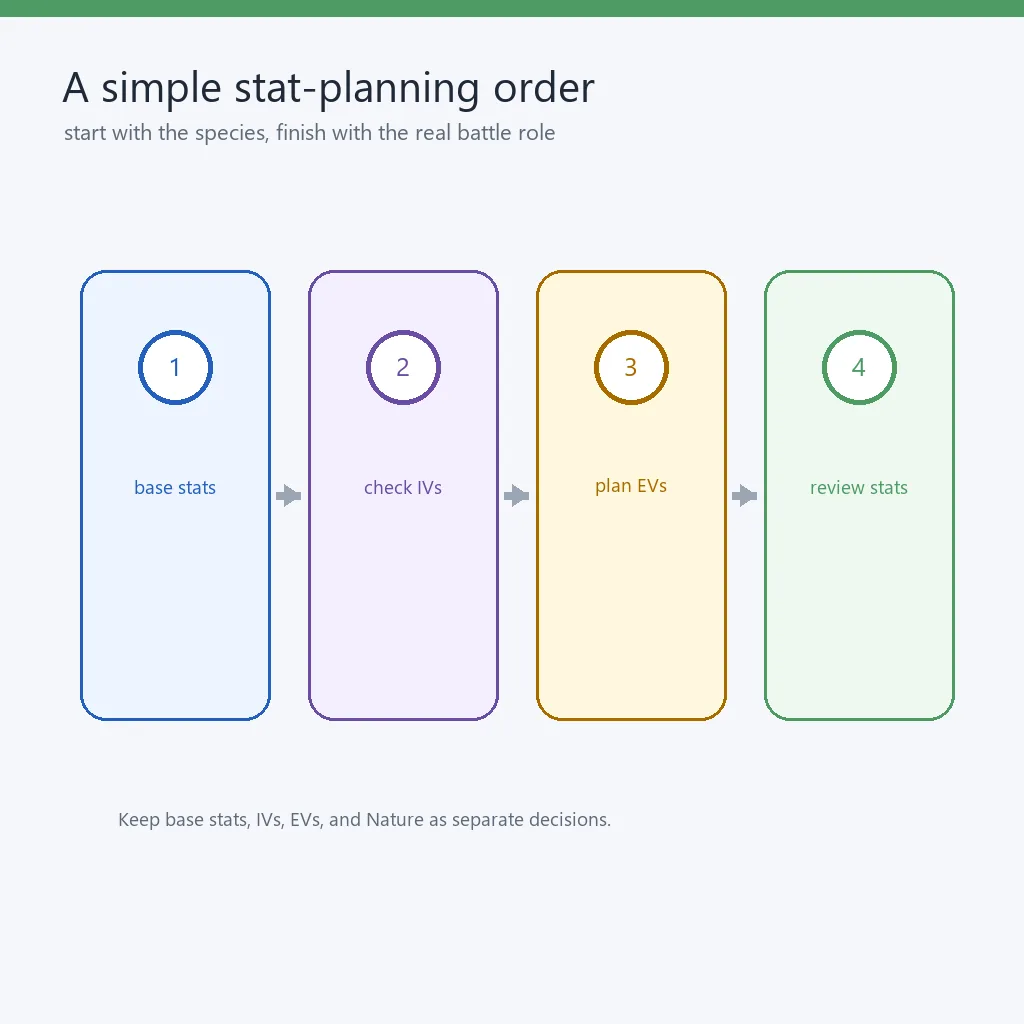
- Choose the role first. Decide whether the Pokemon is meant to attack physically, attack specially, take hits, move quickly, support the team, or do a hybrid job.
- Identify the important stats. Read the base stats and moves together. A Pokemon with strong Special Attack does not automatically want an Attack investment.
- Check the IVs when the game allows it. Judge the values in the target title, but remember that labels and unlock conditions differ between games.
- Spend EVs around a purpose. Start with the two or three stats that actually change the role. A benchmark-based spread can be more useful than a habit-based 252 / 252 template.
- Choose Nature, Ability, and moves as a package. A Nature that raises the wrong stat can erase the benefit of a carefully planned spread. The same EVs can play differently with another Ability or moveset.
- Review the result in the real game. Check the final stat screen, damage or matchup tool, and the rules of the format. If the build is for a different generation or spin-off, start the verification again.
Common mistakes and game boundaries
Confusing base stats with IVs
A species can have a high base stat even when an individual Pokemon has a lower IV in that stat. Base stats belong to the species template; IVs distinguish individual potential. The words describe different layers of the final calculation.
Assuming every game uses the same training system
Modern core-series games share familiar EV and IV language, but a title can award, display, or reset values differently. Older generations, remakes, Pokemon Legends games, spin-offs, and fan formats may use other formulas or terminology. Treat this guide as a map, then verify the game-specific rule.
Copying a spread without checking the moveset
A popular spread is an example, not a law. If the moves, Ability, item, level, or format changes, the best spread may change too. The site's Pokemon Nature Chart explains stat direction, but the right Nature still depends on the build.
Using a calculator without checking its assumptions
Calculators may assume a generation, level, IV, EV, Nature, item, Ability, or damage formula. If the output looks wrong, inspect the inputs first. For defensive questions, compare it with the site's Pokemon Type Chart and Pokemon Weakness Calculator.
Pokemon EVs and IVs FAQ
What are EVs and IVs in Pokemon?
IVs are individual starting potential for each stat, while EVs are trained effort points that you distribute across a limited budget. IVs answer “what did this Pokemon start with?” and EVs answer “where did I invest training?”
Are IVs or EVs more important?
Neither is always more important. IVs affect starting potential, while EVs direct the build toward a role. A good spread can matter more than perfection on a casual team.
What is the maximum number of EVs in Pokemon?
The common modern core-series model uses 510 EVs total and up to 252 in one stat. Earning, display, reset tools, and formulas can vary by title.
Can you change a Pokemon's IVs?
Some games make a stat function as though it has a high IV for battle calculations. That is not always the same as rewriting the stored value for breeding or transfer.
How do you check IVs in Pokemon?
Use the judge, appraisal, or stat-checking feature in the game you are playing. Labels and unlock steps are title-specific.
Do Natures replace EVs and IVs?
No. Nature is a separate modifier; a complete build considers base stats, IVs, EVs, level, Ability, moves, items, and rules together.
Summary
EVs and IVs answer different questions: IVs describe individual potential, while EVs describe chosen training effort. Start with the role, check base stats, inspect IV information, plan the EV spread, then confirm Nature, Ability, moves, and game rules.
Sources and verification
- Bulbapedia: Individual values — terminology, stat potential, and generation notes.
- Bulbapedia: Effort values — EV terminology, limits, and game-specific context.
- Smogon: EVs and IVs — practical training and competitive-build explanations.
- Serebii: Effort Values — compact game reference for checking title-specific behavior.