Pokemon Nature Chart: All 25 Natures and Stat Effects
This Pokemon nature chart lists all 25 Natures and shows which stat each one raises or lowers. Use it as a quick lookup first, then choose a Nature based on the Pokemon's job: physical damage, special damage, speed, defense, or a neutral story-playthrough build.
How Pokemon Natures Work
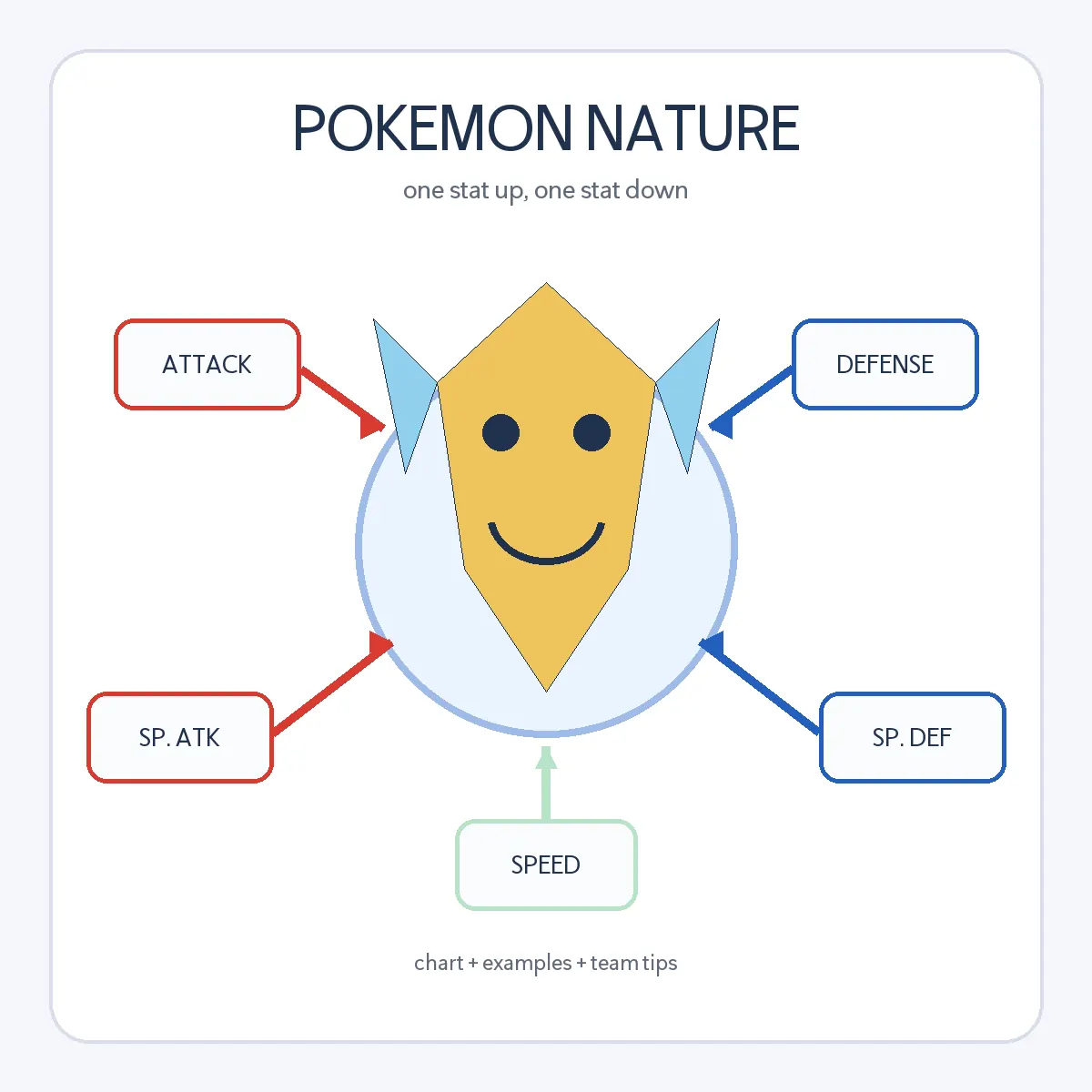
A Nature is a named personality trait attached to a Pokemon. In battle terms, it is best understood as a stat preference rather than a complete personality or a tier ranking. The five affected stats are Attack, Defense, Special Attack, Special Defense, and Speed. HP is not raised or lowered by a Nature.
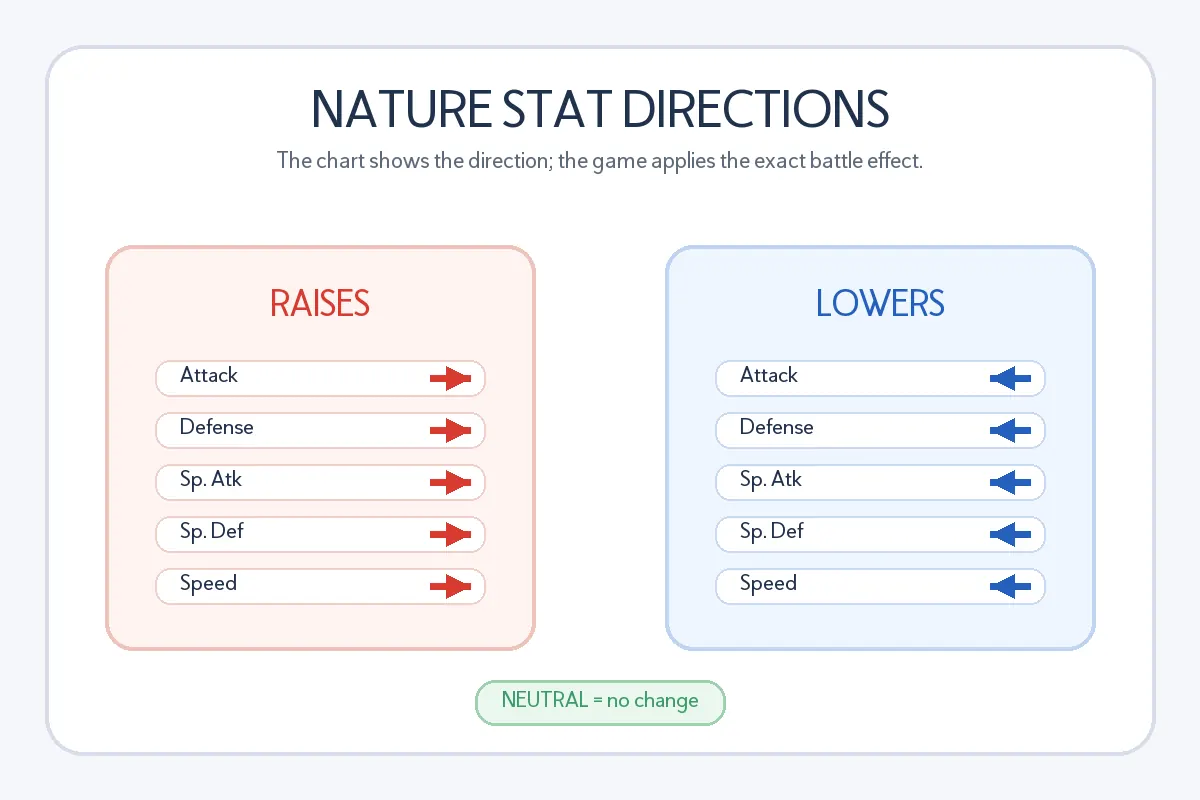
There are 20 changing Natures. Each one pairs a stat that goes up with a different stat that goes down. The remaining three stats do not receive a Nature modifier. For example, Adamant raises Attack and lowers Special Attack, while Timid raises Speed and lowers Attack. This is why the same Nature can be helpful on one build and awkward on another.
The effect is separate from base stats, individual values, effort training, held items, moves, abilities, and battle rules. A Nature does not turn a slow species into a fast one by itself. It gives the build a small directional advantage, so the correct choice depends on what the Pokemon is trying to do.
Complete Pokemon Nature Chart
Use the chart below when you need the exact Nature name. This chart is organized from the 20 stat-changing Natures to the five neutral entries. “Raises” and “Lowers” describe the usual stat-growth direction. A dash means the Nature is neutral for that stat pair; the five neutral Natures are grouped together at the bottom.
| Nature | Raises | Lowers | Common use |
|---|---|---|---|
| Adamant | Attack | Special Attack | Physical damage |
| Bashful | None | None | Neutral |
| Bold | Defense | Attack | Physical defense |
| Brave | Attack | Speed | Power on slower builds |
| Calm | Special Defense | Attack | Special defense |
| Careful | Special Defense | Special Attack | Physical utility |
| Docile | None | None | Neutral |
| Gentle | Special Defense | Defense | Special defense |
| Hardy | None | None | Neutral |
| Hasty | Speed | Defense | Fast mixed role |
| Impish | Defense | Special Attack | Physical defense |
| Jolly | Speed | Special Attack | Fast physical damage |
| Lax | Defense | Special Defense | Physical defense |
| Lonely | Attack | Defense | Physical damage |
| Mild | Special Attack | Defense | Special damage |
| Modest | Special Attack | Attack | Special damage |
| Naive | Speed | Special Defense | Fast mixed role |
| Naughty | Attack | Special Defense | Physical damage |
| Quiet | Special Attack | Speed | Power on slower builds |
| Quirky | None | None | Neutral |
| Rash | Special Attack | Special Defense | Special damage |
| Relaxed | Defense | Speed | Physical defense |
| Sassy | Special Defense | Speed | Special defense |
| Serious | None | None | Neutral |
| Timid | Speed | Attack | Fast special damage |
Chart check: The chart contains 25 named Natures. Use this chart as a lookup, not as a mandatory ranking. The five neutral entries are Hardy, Docile, Bashful, Quirky, and Serious. Every other entry has one raised stat and one lowered stat; the “Common use” column is a guide, not a rule.
How to read the Pokemon nature chart
The Pokemon nature chart is a lookup, not a tier list. Read the Raises column first, then check whether the lowered stat matters for the moves and role you want. The Pokemon nature chart is most useful when you compare two realistic choices, such as Adamant versus Jolly or Modest versus Timid, rather than searching for one Nature that is always best. The same chart also works for casual teams: a neutral Nature can be the clearest choice when you value the Pokemon itself more than a narrow battle benchmark.
How to Choose a Nature for a Pokemon
The fastest way to choose is to start with the role, not the Nature name. Look at the moves and the turn order you want, then use the chart to protect the important stat. If the Pokemon is a favorite rather than a competitive project, a neutral Nature is also a perfectly reasonable choice because it avoids making a stat trade-off for a role you may never use.
For a quick chart check, compare the raised stat with the role you want before reading the common-use label. Return to the chart whenever a move set changes, because the best Nature follows the build rather than the species name alone.
Adamant raises Attack without sacrificing Speed. Jolly trades some Special Attack for Speed when moving first matters. Brave is useful when the build intentionally accepts low Speed.
Modest raises Special Attack without lowering Speed. Timid raises Speed instead. Quiet is a slower option when the build wants power and does not mind moving later.
Bold, Impish, Calm, and Careful protect different defensive goals. Neutral Natures work well when the Pokemon is used for story play, collecting, or an intentionally flexible moveset.
Physical versus special damage
Attack supports physical moves, while Special Attack supports special moves. If a build uses mostly physical moves, lowering Special Attack may be easy to accept, which is why Adamant and Jolly are common reference points. If it uses mostly special moves, Modest and Timid are the matching starting points. Mixed attackers need more care: a Nature that raises one offensive stat may reduce the other, so compare the actual moves rather than choosing from a generic “best Nature” list.
Speed ties and defensive trade-offs
Speed-focused choices are about more than being “fast.” The difference between Timid, Modest, Jolly, and Adamant matters only when the extra Speed changes a matchup or lets the Pokemon act before a threat. Defensive choices work the same way: Bold and Impish both raise Defense, but their lowered stats target different roles. The right answer depends on whether the build needs special moves, physical moves, or a specific defensive benchmark.
Neutral Natures, Mints, and Game Boundaries
Hardy, Docile, Bashful, Quirky, and Serious are neutral Pokemon Natures. They are not “bad” Natures; they simply do not create a stat preference. A neutral Nature can be useful for a casual team, a Pokemon with an unusual mixed moveset, or a collector who values the original encounter more than a particular stat plan.
In modern core-series games, Mints let you change the stat-growth effect used for training. The useful distinction is that a Mint does not rewrite the stored Nature shown as the Pokemon's original Nature. For breeding, records, flavor text, and some game systems, that difference can matter. If you are planning a team, think of the Nature as identity data and the Mint as a training adjustment.
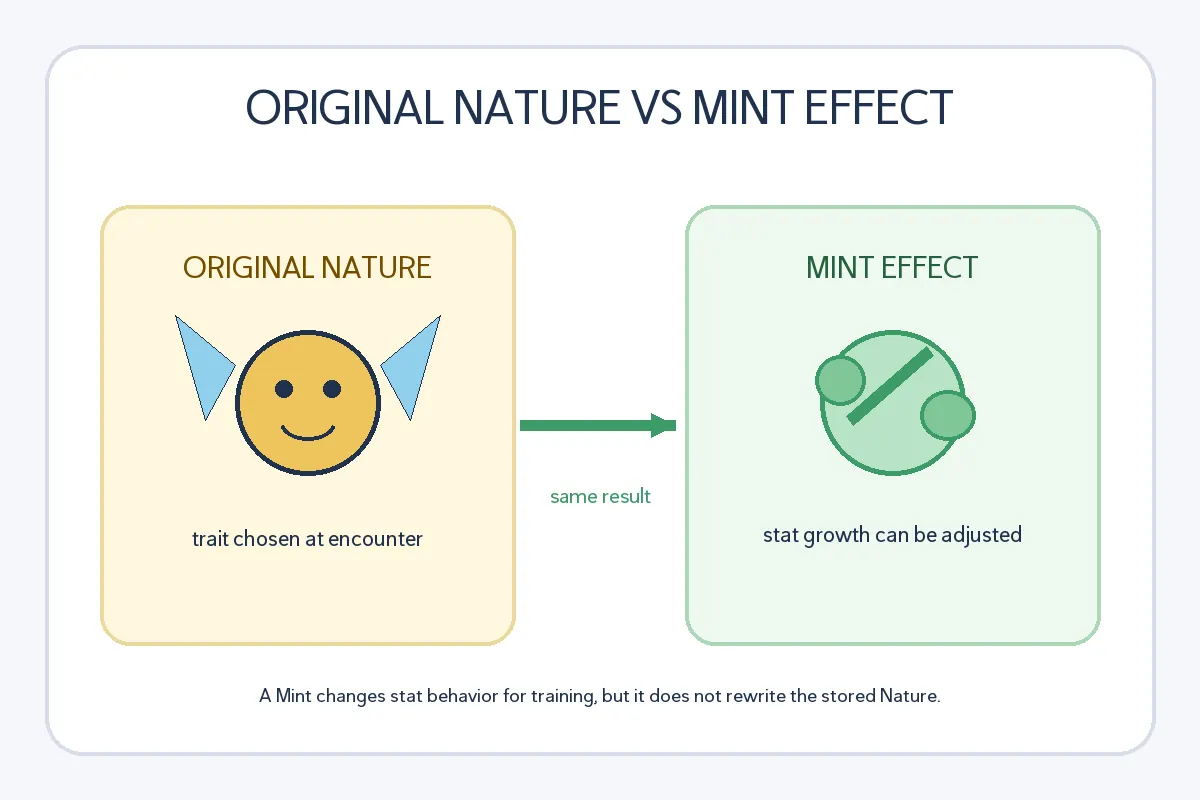
Rules can differ between the main series, remakes, spin-offs, and individual game generations. This chart describes the standard modern core-series idea of Nature stat directions. It does not replace a game-specific guide when you need encounter rules, breeding behavior, flavor preferences, or an exact competitive format calculation.
Practical Examples and Limits
Suppose a fast special attacker uses mostly special moves. Timid is a sensible chart lookup because it raises Speed and lowers Attack, a stat the moves may not use. A slower physical attacker could prefer Adamant or Brave depending on whether it wants to preserve Speed or deliberately trade Speed for Attack. These are starting points, not automatic answers: abilities, items, move priority, team support, and the opponent's format can change the decision.
For a six-Pokemon project, choose each Nature with the full team in mind. A team can be made of favorite Pokemon first and optimized second. The site's Pokemon Team Picker helps you assemble six choices, while the Pokemon Abilities Guide explains another layer that can change how a Pokemon performs. If your starting point is a generation or type rather than a battle role, use the Pokemon generations list and then return to the chart.
Important limit: a Nature does not determine a Pokemon's complete strength. Base stats, individual values, effort training, moves, abilities, items, level, and battle rules still matter. Use this page to make the stat-direction choice clear, not to replace a complete damage calculation.
Pokemon Nature Chart FAQ
How many Pokemon Natures are there?
There are 25 named Natures. The chart lists 20 stat-changing entries and five neutral entries: Hardy, Docile, Bashful, Quirky, and Serious. Each neutral Nature raises and lowers the same stat.
Which Pokemon Nature is best?
There is no universal best Nature. Adamant or Jolly can fit a physical attacker, while Modest or Timid can fit a special attacker. Choose from the moves, role, and Speed plan.
What are neutral Pokemon Natures?
Hardy, Docile, Bashful, Quirky, and Serious are neutral. They do not create a net increase or decrease in the five main battle stats.
Do Mints change a Pokemon's Nature?
In modern core-series games, a Mint changes the stat-growth effect used in training but does not rewrite the stored Nature. Keep the two concepts separate when checking a Pokemon's summary or records.
Should I choose a Nature before building a team?
Choose it after you know the Pokemon's role and important moves. For a casual favorite team, a neutral Nature is also valid when you do not want to sacrifice a stat for a role.
Summary
The Pokemon nature chart is a role-planning tool. Start by deciding whether a Pokemon mainly attacks physically, attacks specially, needs Speed, or wants a defensive trade-off. Then use the 25-row chart to find the matching Nature. Use the chart again when you change the moveset. Neutral Natures remain useful for flexible and casual builds, while Mints can adjust stat behavior in modern games without changing the stored Nature identity.
Sources and verification
- Pokémon Database Nature mechanics — cross-check for the 25 Nature names and raised/lowered stat pairs.
- Bulbapedia Nature reference — broader cross-check for Nature mechanics, neutral Natures, and game-specific caveats.