Pokemon Trivia: 40 Questions and Answers for Fans
This Pokemon trivia guide gives you 40 questions to answer before you check the solutions. The set starts with easy Pokedex and Kanto facts, moves into types and evolutions, then finishes with generation history and a short challenge round. Each answer includes a quick explanation so the page works as both a self-test and a compact Pokemon knowledge review.
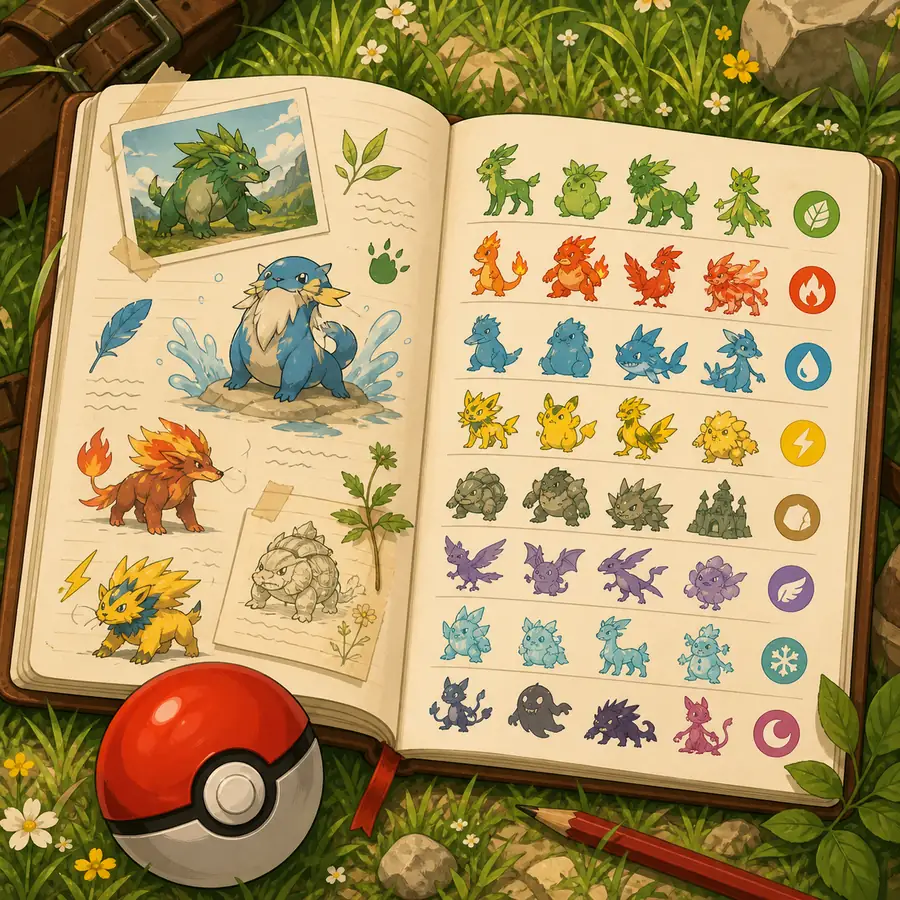
How to Use These Pokemon Trivia Questions
For a solo quiz, read the question first and pause before looking at the answer. For a group game, let one person keep the answer text hidden while another person reads the question aloud. The explanations are deliberately short: they give you a fact to remember without turning every question into a long encyclopedia entry.
Start with the question and say or write your answer before checking the solution.
Give yourself one point for a correct answer. Do not subtract points for a guess.
Use the explanation after each answer to connect the fact to a type, Pokedex number, or game era.
Expert territory: you can probably handle the challenge section without hints.
Strong fan knowledge: revisit the explanations for the questions you missed.
Good starting point: the easy round gives you a quick foundation for later questions.
Easy Pokemon Trivia Questions
These first 14 questions focus on familiar names, the original Kanto region, and Pokedex facts. They are designed as an approachable warm-up for a Pokemon trivia night or a quick knowledge quiz.
1.Which Pokemon is #001 in the National Pokedex? Easy
Answer: Bulbasaur. The Grass/Poison starter is the first entry in the National Pokedex order.
2.Which region is the setting for the original Pokemon games? Easy
Answer: Kanto. The region introduced in Pokemon Red, Green, Blue, and Yellow is home to the original 151 Pokemon.
3.What type is Pikachu? Easy
Answer: Electric. Pikachu is the best-known example of a pure Electric-type Pokemon.
4.What is Charmander's final evolution? Easy
Answer: Charizard. Charmander evolves into Charmeleon and then Charizard, a Fire/Flying Pokemon.
5.What are the three original starter types? Easy
Answer: Grass, Fire, and Water. The Kanto starter trio is Bulbasaur, Charmander, and Squirtle.
6.Which Pokemon is #025 in the National Pokedex? Easy
Answer: Pikachu. Its pre-evolution Pichu is #172, while Raichu is #026 in the National Pokedex.
7.Which Pokemon is #151 in the original Kanto Pokedex? Easy
Answer: Mew. Mew is the final entry of the original 151 and is associated with the New Species category.
8.Which three Pokemon make up the classic Kanto legendary bird trio? Easy
Answer: Articuno, Zapdos, and Moltres. Their names and designs point to Ice, Electric, and Fire themes.
9.What is Snorlax famous for doing? Easy
Answer: Sleeping and blocking paths. Snorlax is the Sleeping Pokemon, and its early-game roadblock is one of the series' memorable encounters.
10.Which move is Magikarp famously associated with? Easy
Answer: Splash. The move is famously weak in normal battle use, which makes Magikarp's later evolution into Gyarados a classic surprise.
11.Which move lets Ditto copy the opposing Pokemon's appearance? Easy
Answer: Transform. Ditto's identity is built around copying the opponent rather than having a conventional evolution line.
12.What are Bulbasaur's two types? Easy
Answer: Grass and Poison. Bulbasaur is one of the original dual-type starter Pokemon.
13.Which three stones evolve Eevee in the original games? Easy
Answer: Water Stone, Thunder Stone, and Fire Stone. They evolve Eevee into Vaporeon, Jolteon, and Flareon.
14.Which three characters are the classic Team Rocket trio in the animated series? Easy
Answer: Jessie, James, and Meowth. The trio's repeated attempts to capture Pikachu became a recurring part of the show.
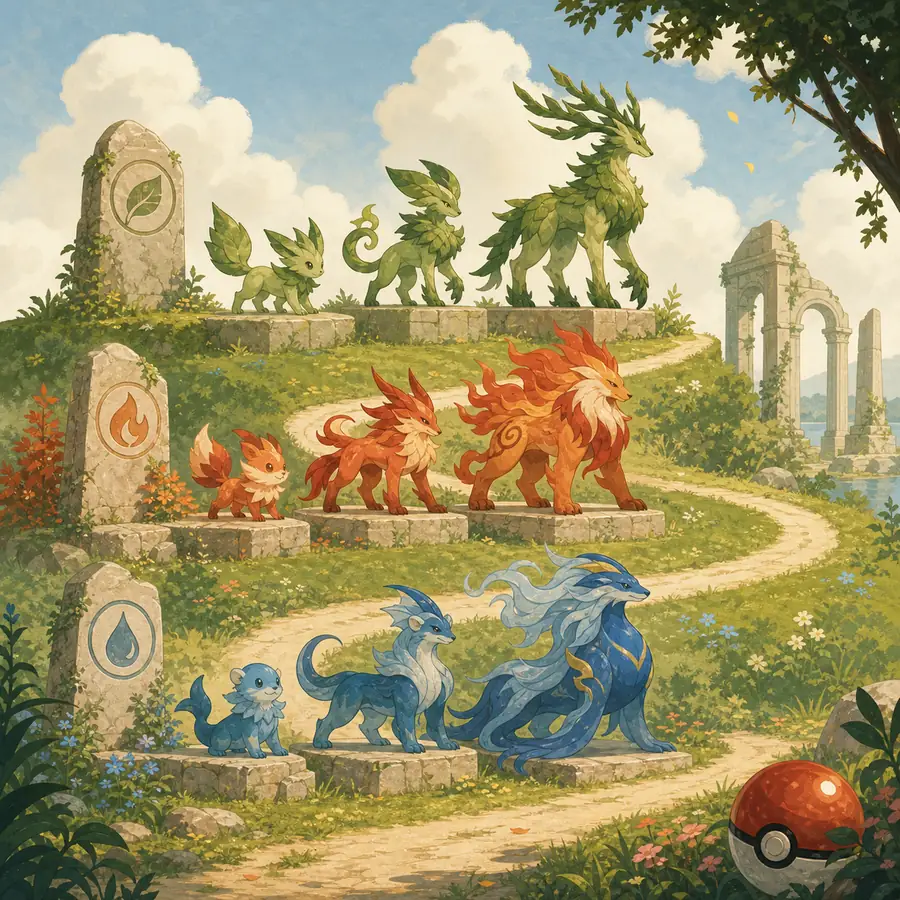
Pokemon Types, Moves, and Evolution Trivia
This section moves from name recognition to the rules that make a Pokemon team or matchup interesting. If you enjoy battle references, compare these answers with the site's Pokemon Type Chart and use the Pokemon Weakness Calculator for a specific team.
15.Which two common types are super effective against Water? Medium
Answer: Electric and Grass. The standard main-series chart lists both as 2x matchups against Water.
16.Why does an Electric-type move fail against a Ground-type Pokemon? Medium
Answer: Ground is immune to Electric. The type matchup is 0x before other effects are considered.
17.Which item evolves Pikachu into Raichu? Medium
Answer: A Thunder Stone. The evolution is stone-based rather than level-based.
18.What item and method are used to evolve Onix into Steelix? Medium
Answer: Trade Onix while it holds a Metal Coat. Both the held item and the trade method are part of the evolution condition.
19.Which Pokemon evolves from Metapod? Medium
Answer: Butterfree. The early Bug-type line is Caterpie, Metapod, and Butterfree.
20.What are Charizard's two types in the standard main-series games? Medium
Answer: Fire and Flying. Its type combination is different from Charmander and Charmeleon, which are pure Fire.
21.What is Mewtwo's National Pokedex number? Medium
Answer: #150. Mew follows it as #151, which is why the two are closely connected in Kanto trivia.
22.How many standard Eeveelutions are there in the current main-series family? Medium
Answer: Eight. The family includes Vaporeon, Jolteon, Flareon, Espeon, Umbreon, Leafeon, Glaceon, and Sylveon.
23.Which type was introduced in Generation 6? Medium
Answer: Fairy. Fairy changed several older matchups and gave Dragon-type Pokemon a new major weakness.
24.Which type is immune to Dragon-type attacks in the standard chart? Medium
Answer: Fairy. This immunity is separate from Fairy's other interactions with Dragon moves and helps define the matchup.
25.What happens when a dual-type Pokemon is weak to an attack with both of its types? Medium
Answer: The 2x multipliers combine to make 4x. Type effectiveness is multiplied across the two defending types; it is not averaged.
26.Which type is Water super effective against in the classic starter matchup? Medium
Answer: Fire. Water, Fire, and Grass form the familiar triangle used by many starter choices.
27.Which Pokemon evolves with a Moon Stone from the original Kanto group? Medium
Answer: Clefairy evolves into Clefable. The Moon Stone is one of the original evolutionary stones used in Kanto.
28.What are Gengar's original main-series types? Medium
Answer: Ghost and Poison. Gengar's dual typing is part of why it is a recurring answer in type and evolution trivia.
Generations and Game-History Trivia
These questions test whether you can connect a Pokemon fact to its generation or region. If you want a longer chronology, see the site's Pokemon Generations List and compare the regional starter groups on Pokemon Starters by Generation.
| Fact to remember | Answer | Why it matters |
|---|---|---|
| 29. Which generation introduced Dark and Steel types? | Generation 2 | Johto expanded the type system beyond the original Kanto set. |
| 30. How many Pokemon were in the original Kanto roster? | 151 | The original 151 remain the foundation of many Pokemon trivia questions. |
| 31. Which released generation added the most new species? | Generation 5 | Unova introduced 156 new species, the largest single-generation addition. |
| 32. Which region is associated with Generation 3? | Hoenn | Hoenn is known for its weather-focused legendary trio and island geography. |
| 33. Which region is associated with Generation 7? | Alola | Alola introduced island trials, regional forms, and Z-Moves. |
| 34. Which region is associated with Generation 8? | Galar | Galar introduced the stadium-focused Gym Challenge and Dynamax mechanics. |
| 35. Which region is associated with Generation 9? | Paldea | Paldea is the open-world setting connected with Terastallization. |
| 36. How many standard Pokemon types are used in the modern main-series chart? | 18 | The type chart includes Normal through Fairy, with each type having its own matchup pattern. |
Generation names are useful clues, but they are not a substitute for checking a specific game. Remakes, regional forms, spin-offs, and later mechanics can change how a familiar Pokemon or type behaves. For a personal preference answer rather than a history question, try the Pokemon Personality Quiz or the Pokemon Type Quiz.
Bonus Challenge Pokemon Trivia
The final four are still answerable from standard references, but they are easier to mix up if you only remember a Pokemon's design and not its Pokedex context.
37.Which Pokemon evolves from Pichu? Challenge
Answer: Pikachu. Pichu is the baby Pokemon, Pikachu is the middle stage, and Raichu is the Thunder Stone evolution.
38.Which stone turns Eevee into Vaporeon? Challenge
Answer: Water Stone. The matching stones for Jolteon and Flareon are the Thunder Stone and Fire Stone.
39.Which Pokemon is #143 in the National Pokedex? Challenge
Answer: Snorlax. Its late-Kanto number is one reason it appears in both Pokedex and game-history trivia.
40.Which Pokemon evolves from Magikarp? Challenge
Answer: Gyarados. The dramatic change from a weak fish-like Pokemon to a powerful Water/Flying Pokemon is one of the series' most familiar evolution surprises.
Pokemon Trivia FAQ
How should I use this Pokemon trivia page?
Read each question before looking at the answer, give yourself one point for a correct answer, and use the explanations to review the facts you missed. You can also read the page aloud as a small Pokemon trivia game for friends.
Are these Pokemon trivia questions official?
This is a fan-made trivia guide, not an official Pokemon quiz. The answers follow standard main-series Pokedex, type, evolution, and generation references, and the source links below are provided so you can check details.
How many Pokemon trivia questions are on the page?
There are 40 questions: 14 easy questions, 14 type and evolution questions, 8 generation questions, and 4 challenge questions.
What should I use if I want an interactive Pokemon quiz instead?
Use the Pokemon Personality Quiz for a matched Pokemon result or the Pokemon Type Quiz for a type profile. This page is a readable trivia question-and-answer guide rather than a scored browser app.
Summary
Good Pokemon trivia mixes easy recognition with facts that reward careful reading: Pokedex numbers, type interactions, evolution methods, and generation history. Start with the 14 easy questions, use the explanations to fill gaps, and then try the challenge round without looking at the answers. When you want to turn your knowledge into a personal favorite list, return to the Favorite Pokemon Picker.
Sources and Verification
- Official Pokémon Pokédex — first-party reference for species names, numbers, types, and basic category context.
- Bulbapedia National Pokédex reference — community cross-check for numbering, evolution lines, and generation history.
- Bulbapedia type reference — community cross-check for type relationships, immunities, and modern chart terminology.
- Pokémon Database National Pokédex — secondary reference for species order, types, and evolution context.