Pokemon Breeding Guide: How Eggs, IVs, Moves, and Natures Work
This Pokemon breeding guide explains the whole egg-making loop in plain English. You will learn how to choose compatible parents, where the offspring species comes from, what can be inherited, how Egg Moves fit into the process, and why a rule that works in one title may fail in another. Use it as a starting map before checking the exact game you are playing.
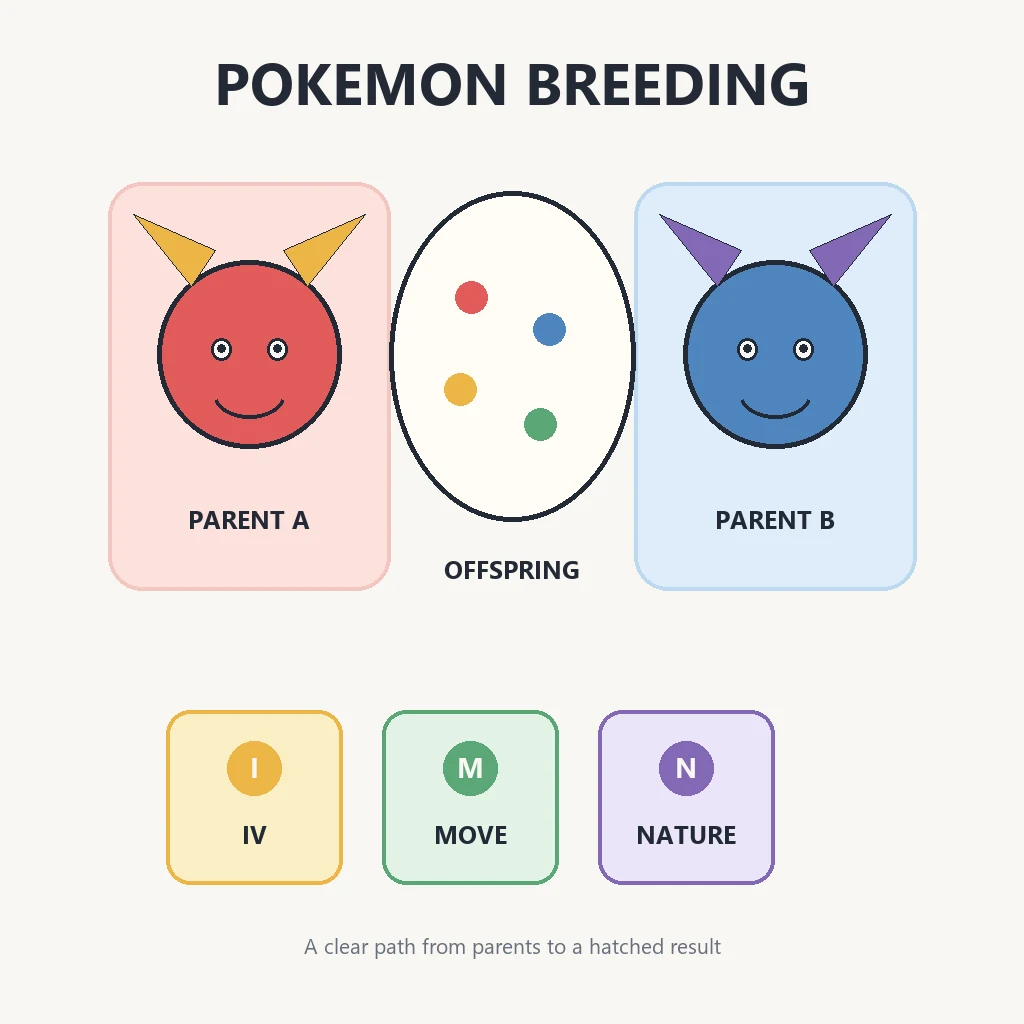
What is Pokemon breeding?
Breeding is a game system that lets two compatible Pokemon produce an egg. The egg normally hatches into a baby species connected to one of the parents, rather than becoming a random Pokemon. That makes breeding useful for completing a collection, obtaining a preferred move, planning inherited traits, or raising a new member for a team.
The name changes by title: older games commonly use a Day Care, while newer games may use a nursery or overworld picnic system. The core questions stay the same: are the parents compatible, what species will hatch, and which traits can be passed on?
Check Egg Groups, sex rules, Ditto exceptions, and whether the species is allowed to breed.
IVs, Nature, and Ability outcomes may be influenced by parents or items, but never assume the rule is universal.
Egg Moves and the baby species are separate checks. Confirm both before you begin a long breeding chain.
How to choose compatible parents
The first step in how to breed Pokemon is finding a pair the game recognizes as compatible. In the familiar core-series model, two parents can breed when they share an Egg Group and meet the game's sex rules. A male and female from the same compatible group is the simple beginner example. Some species can use Ditto to cover a different pairing, while genderless species often depend on a Ditto-style exception if the title supports it.
Compatibility is not the same as sharing a type, evolution line, or appearance. Two Water-type Pokemon may be incompatible, while two differently typed species may match. Check the species and form instead of guessing.
Some Pokemon belong to a group that cannot breed normally. Legendary, Mythical, baby, and special event species are common examples of cases that need extra care, but the exact list is game-specific. If the breeding location refuses to produce an egg, check the species rule first before changing items or walking farther.
How the egg species is decided
Once the parents are compatible, the egg species is usually tied to the non-Ditto parent or to a defined parent species rule. This is why the same compatible pair can be valuable for a move or trait but still produce only one expected baby species. Evolution stage also matters: a parent may produce the earliest ordinary stage in its family rather than hatch as the parent's current evolved form.
Forms, regional variants, incense requirements, and special species rules can create exceptions. Before collecting a batch, confirm the baby species, inheritable form, and any required item in the target game.
What can parents pass down?
Breeding is not one inheritance roll. Different parts of the offspring are determined by different rules. The parent setup may influence IVs, Nature, Ability, move list, ball or cosmetic data, and other title-specific properties, but those categories do not all follow the same path.
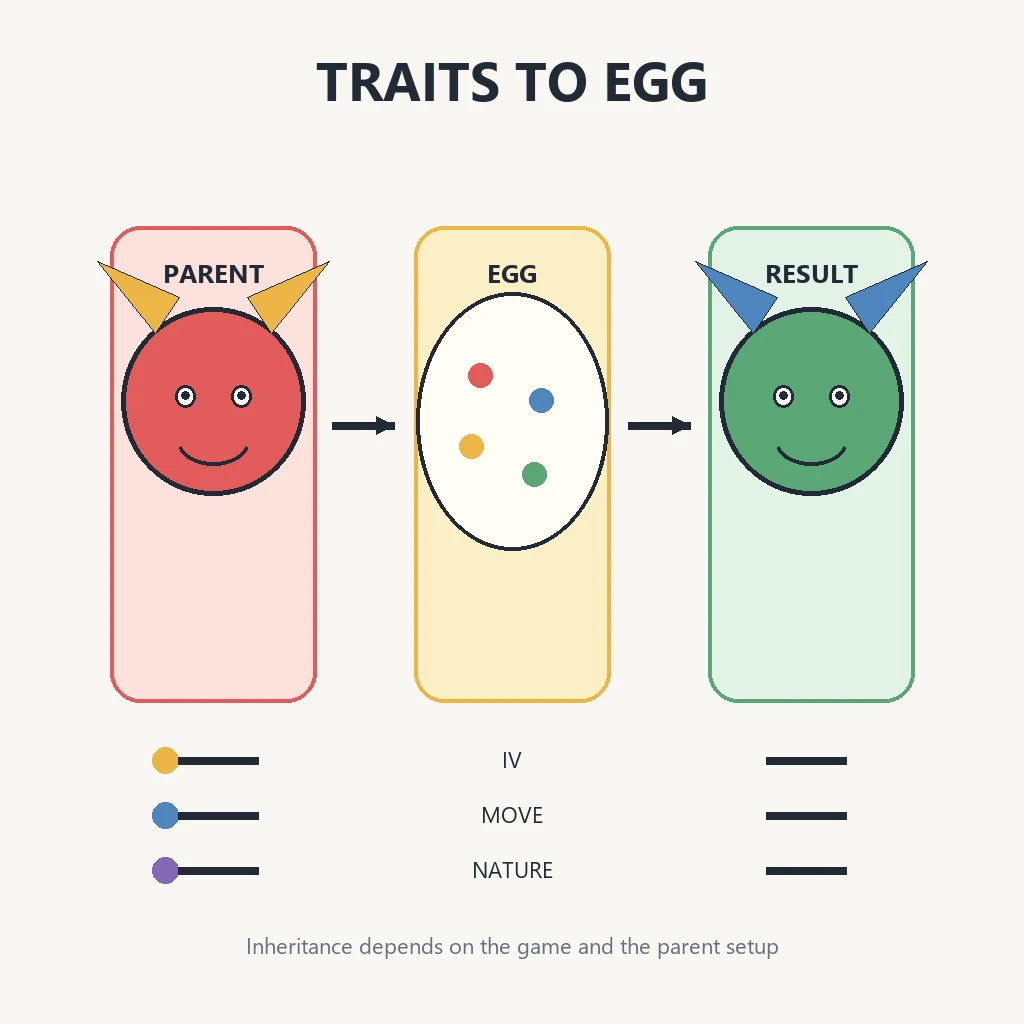
| Trait | What to check | Practical advice |
|---|---|---|
| IVs | How many values are inherited and whether an item changes the selection. | Plan the parent values first. The Pokemon EVs and IVs Guide explains why inherited potential is different from later EV training. |
| Nature | Whether a parent or held item can influence the offspring Nature. | Choose a Nature that matches the intended role, then verify the title-specific item rule. |
| Ability | Species, Ability slot, parent type, and game-specific inheritance rules. | Do not assume a Hidden Ability passes at the same rate as a regular Ability. |
| Egg Moves | Whether the parent knows the move and whether the game uses breeding or a move-transfer method. | Check the move list and compatibility before starting a chain. |
| Hatching | Egg cycle, party space, hatching ability, and any title-specific speed bonus. | Use a safe hatching route and keep an empty party slot available. |
How Egg Moves work in Pokemon
Egg Moves are moves that a baby may receive through a compatible parent or another title-specific transfer method. They are different from ordinary level-up moves: the move is part of the breeding plan, so you need to check the parent species, the move list, and the version of the game before you start.
Older systems usually require a compatible parent that already knows the move. Some newer games add a separate transfer method, so a generic “best breeding method” can be misleading. Verify the title before starting.
For a reliable move chain, write down three things: the baby species you need, the move you want, and the parent that can legally provide it. Then check whether the move is available in the target game. If the move is not in that game's learnset, no amount of repeated hatching will fix the plan.
How to breed Pokemon step by step
This short workflow works as a planning checklist across many breeding systems:
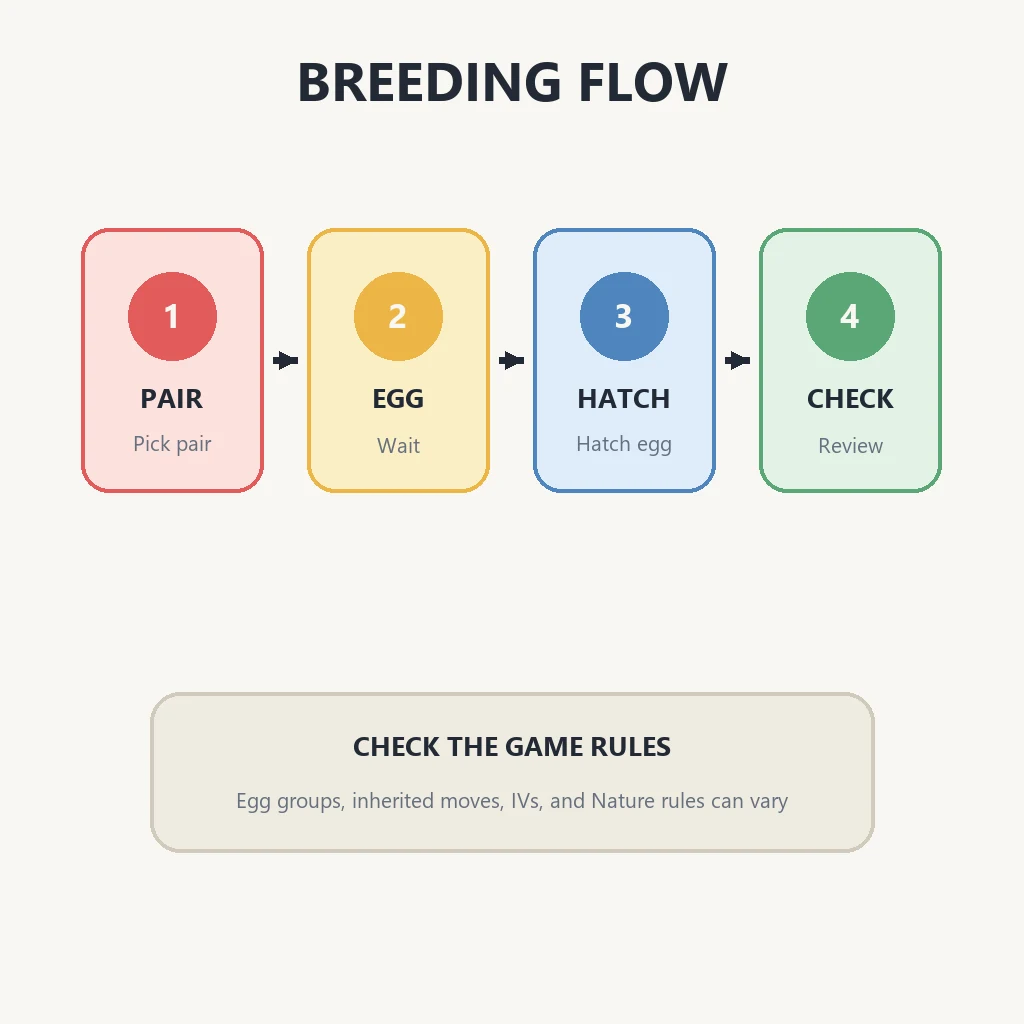
- Define the result. Decide the baby species, Nature, Ability, Egg Move, and IV goals before choosing parents. A casual collection egg needs less preparation than a carefully planned battle build.
- Confirm compatibility. Check Egg Groups, sex, Ditto rules, special species restrictions, and the form that can actually produce the desired offspring.
- Prepare the parents. Teach the needed move, choose the parent with the useful Nature or Ability, and equip only the items supported by the target game.
- Start the breeding loop. Use the game's nursery, Day Care, picnic, or equivalent system. Keep party space available and collect the egg using the method the title provides.
- Hatch and inspect. Check species, Nature, Ability, move list, and IV information. If one result is wrong, identify which inheritance rule failed instead of changing every variable at once.
- Repeat with a better parent. Keep a useful offspring when it improves the next generation. Breeding becomes faster when each generation preserves one more part of the final target.
Pokemon breeding items and common mistakes
Searches for Pokemon breeding items often mix together three different jobs: items that influence inherited data, items that help hatching, and items that unlock or modify a particular species or move outcome. Treat those as separate categories. The best item is the one that solves the current bottleneck, not the one that appears most often in a general list.
The most common mistake is using a real rule from the wrong game. A parent item may control Nature in one title, a different item may influence inherited IVs, and a move-transfer mechanic may replace the old Egg Move route in another. If your result looks impossible, compare the game's generation, remake, regional version, and current rules before assuming the egg system is broken.
Do not change too many variables at once. A short log of parent species, held items, target Nature, target move, and batch result makes a failed plan easier to diagnose.
Pokemon breeding guide FAQ
How do you breed Pokemon?
Choose compatible parents, place them in the game's breeding system, collect the egg, hatch it, and inspect the result. Compatibility and the collection method depend on the title.
What Pokemon can breed together?
Usually, parents need compatible Egg Groups and compatible sex rules. Ditto covers special pairings in many core-series games, while some species cannot breed normally.
Do Pokemon pass down IVs from their parents?
Many games allow some IV inheritance, but the number and item rules vary. Check the target title before building a parent around a specific IV plan.
How do Egg Moves work in Pokemon?
An Egg Move can come from a compatible parent or a newer game-specific transfer method. Confirm the move list and the legal route for your title.
Can a Pokemon pass down its Nature?
Often yes through a supported parent or item setup, but the exact rule is game-specific. Nature is separate from IVs and EVs.
What are the best Pokemon breeding items?
It depends on whether you need inherited data, faster hatching, a move, or a special species result. Use a title-specific item list and change one variable at a time.
Summary
A successful breeding plan starts with the result you want, not with random egg batches. Confirm compatible parents, verify the egg species, separate IV, Nature, Ability, and move inheritance, then hatch and inspect each generation. When a rule looks familiar but does not work, check the exact game before trying more items or more eggs.
Sources and verification
- Pokémon Database: Breeding — practical overview of breeding compatibility, eggs, and inheritance concepts.
- Bulbapedia: Pokémon breeding — detailed species, generation, Egg Group, and game-specific reference notes.
- Serebii: Breeding — additional title-specific breeding reference material.