Shiny Pokemon Guide: Odds, Methods, and Game Differences
This Shiny Pokemon guide explains the rare alternate-color forms, what encounter odds mean, and how to choose a hunting method. Start with the exact game and target species: rates, alerts, available boosts, and even whether a Pokemon can appear Shiny are title-specific.

What is a Shiny Pokemon?
A Shiny Pokemon is a rare version with an alternate color palette. It is still the same species, not a separate type, evolution, or battle class.
How the game reveals it varies. Some titles show alternate colors on the overworld model; others wait until an encounter or battle. Sparkle, sound, and collection-screen cues are not universal, so look up a hard-to-see target in the exact game.
Availability is separate from rarity. A species may require an event, transfer, raid, or version, and some encounters are locked to normal colors. Confirm the target is eligible before starting.
Pikachu
 Regular
 Shiny
Gyarados
 Regular
 Shiny
How Shiny Pokemon odds work
Odds such as 1 in 4,096 describe one eligible random roll, not the number of encounters required. With independent rolls, a miss does not increase the next chance unless the game explicitly uses a pity or chain rule.
For example, if a game uses a 1-in-4,096 rate for a particular encounter, completing 4,096 eligible rolls gives about a 63% chance of seeing at least one Shiny, not a guarantee. The probability after n independent rolls is 1 - (1 - p)n, where p is the per-roll chance. This is why one player can find a Shiny quickly while another can pass the average without seeing one.
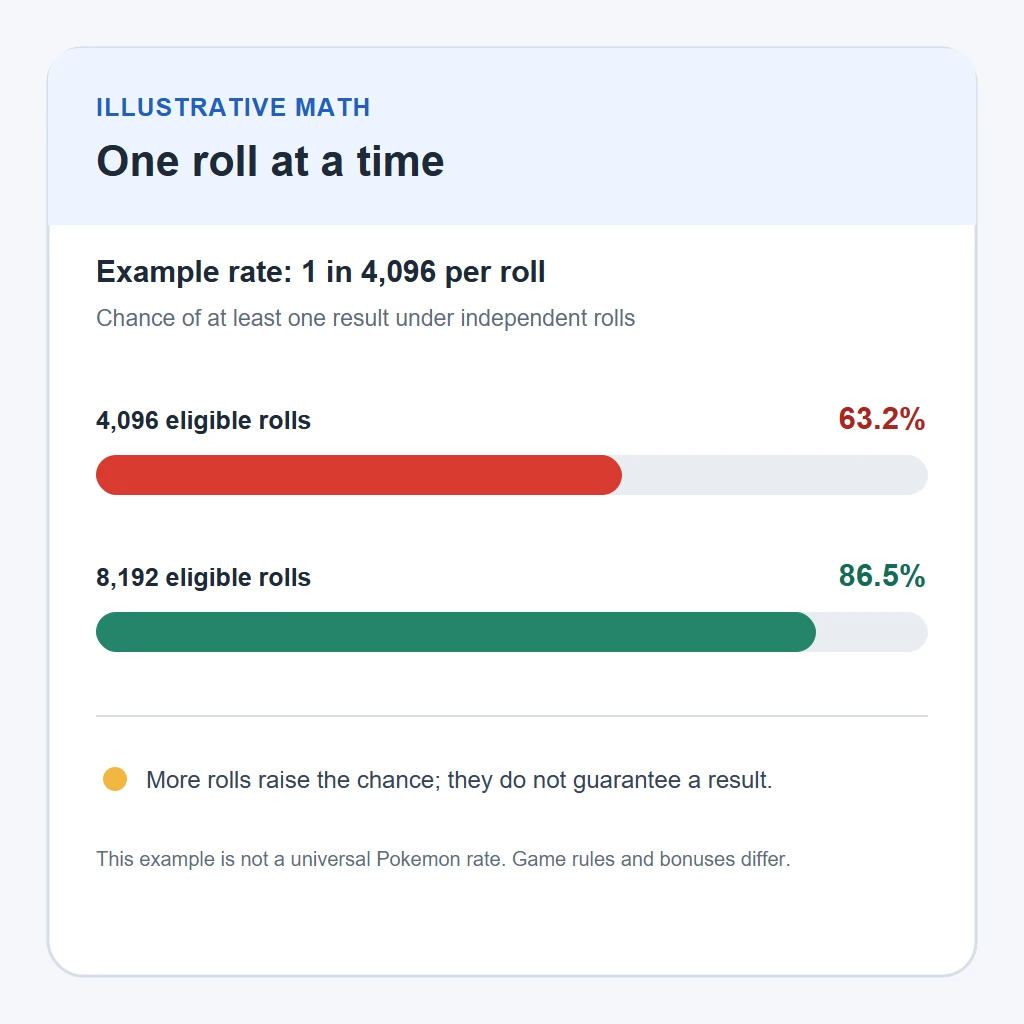
Before comparing rates, check what each one counts. A wild encounter, egg, static Pokemon, gift, raid, or event may use a different rule. A charm, outbreak, chain, or meal bonus affects only eligible rolls. Confirm whether a source describes a base rate, a boosted rate, or the chance after an entire hunt.
Common Shiny hunting methods
No method is best for every game. Choose by target availability, setup, and the kind of play you enjoy. These broad categories are not available in every title.
| Method | When it can help | Check before starting |
|---|---|---|
| Wild encounters | When the species is available in an area and each encounter creates an eligible roll. | Spawn conditions, encounter rules, and whether the game reveals Shiny colors before battle. |
| Outbreaks or chains | When a title has a group encounter, chaining, or progress bonus for repeated targets. | Whether progress resets, what actions advance it, and which bonus is actually active. |
| Breeding | When the target can hatch from an egg and the game supports a breeding odds method. | Parent compatibility, egg availability, language settings, and the title's inheritance rules. See the Pokemon Breeding Guide for egg basics. |
| Static or event encounters | When a specific gift, legendary, raid, or event is the only route to the target. | Shiny lock status, event dates, reset behavior, and any distribution restrictions. |
| Mobile or spin-off games | When the game has its own field research, event, raid, or collection system. | Use that game's current rules. Main-series odds should not be copied to a spin-off. |
A Scarlet and Violet example
Pokemon Scarlet and Pokemon Violet are a useful labeled example. Guides commonly document a 1-in-4,096 base rate for eligible wild encounters. The official trainers' guide says registering 400 Paldea Pokedex entries earns the Shiny Charm, which makes wild Shiny encounters more likely. It is a boost, not a guarantee.
These games also have Mass Outbreaks and the Sparkling Power meal effect. Their values depend on the active conditions and combination, so consult a current Scarlet and Violet reference for the threshold, recipe, or combined rate. Do not apply those numbers to another generation, remake, Pokemon GO, or future release.
For a named target, the practical order is: verify that it appears in your version, confirm it is not Shiny-locked, choose an eligible area or outbreak, then decide whether a supported boost is worth the setup. This avoids a common trap: following a correct guide for the wrong game or a method that cannot produce the target at all.
Plan a Shiny hunt step by step
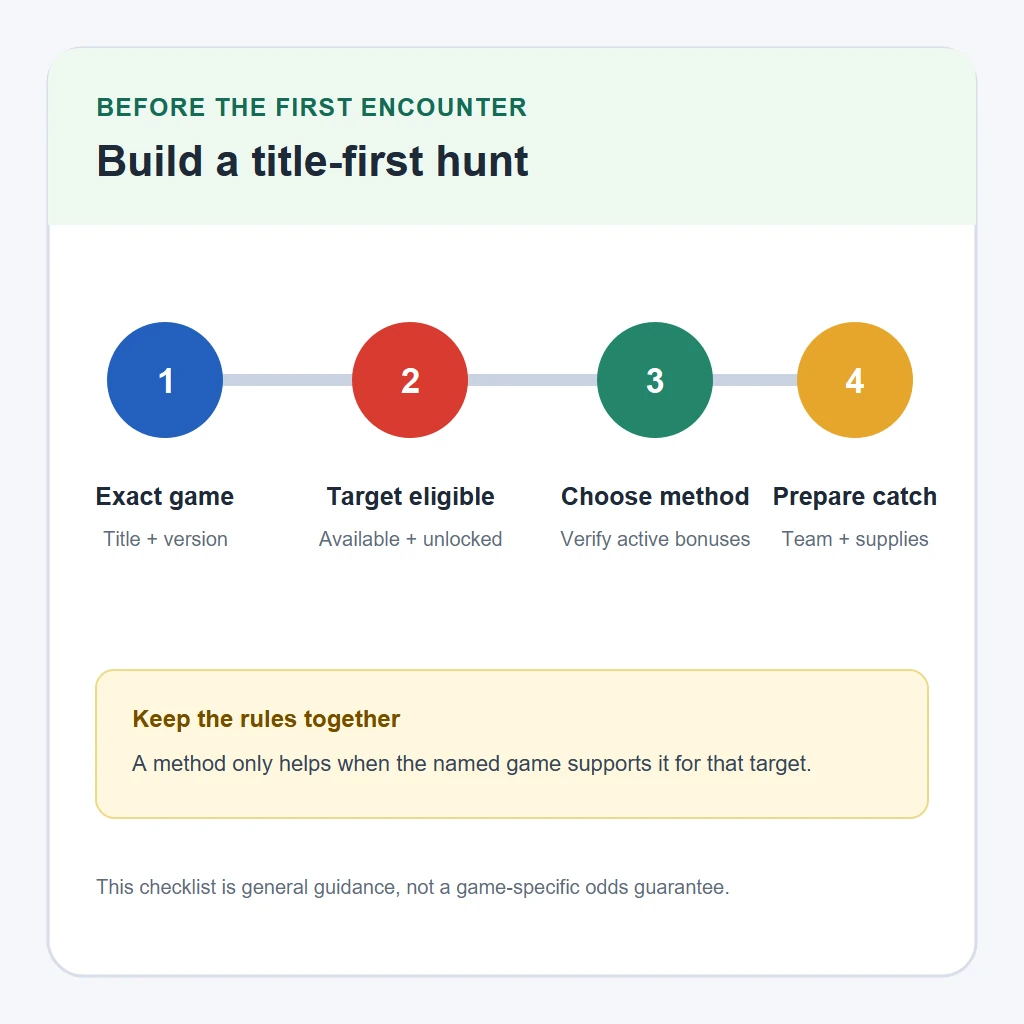
- Name the exact game and version. Record the title, edition, update or event context, and target species. Similar names across games do not mean the encounter system is the same.
- Confirm the target is obtainable and eligible. Check its location, form, event requirement, and Shiny-lock status. If the method depends on eggs, confirm the species can hatch in that title.
- Choose the method you can repeat. Compare wild encounters, breeding, outbreaks, or another supported route. A theoretically faster method is not useful if it requires an unavailable item or a setup you do not want to maintain.
- Check the active odds and boosts. Separate the base chance from bonuses. Read the fine print for the exact encounter type, chain state, charm, meal, or event instead of adding percentages from unrelated guides.
- Prepare for recognition and capture. Learn the species' alternate palette and what cue the game provides. Bring a suitable team and capture supplies if a battle can knock out, flee from, or otherwise end the encounter.
- Track attempts without treating an average as a deadline. A counter can help pace a hunt, but it does not make the next encounter more likely under independent odds. Take breaks when repetition stops being fun.
Mistakes that waste a hunt
Mixing game rules: a charm, chain, outbreak, or breeding bonus may exist in one title and be absent or different in another. Always include the game name when you search for a method.
Counting the wrong thing: a reset, egg, spawn check, or defeated Pokemon may or may not create the roll you think it does. Follow a guide that explains what counts as an attempt for that method.
Assuming the palette is obvious: some alternate colors are easy to miss, and not every game adds a sound or effect. Study a reliable sprite or game-specific reference before a long hunt. You can also use the site's Shiny Mode to compare many alternate sprites for fun; it is a visual picker feature, not a live encounter or odds tool.
Ignoring capture risk: a rare encounter is easier to lose when a move can knock it out or a turn limit is involved. Prepare a safe plan for the target, and check whether saving before an encounter is appropriate in that game. Do not assume a general capture tip works in every battle system.
Shiny Pokemon FAQ
What are the odds of finding a Shiny Pokemon?
There is no single rate for every game. Odds depend on the title, encounter type, and active bonuses. Scarlet and Violet guides commonly document a 1-in-4,096 base rate for eligible wild encounters, but treat that as a game-specific example.
Does the Shiny Charm guarantee a Shiny?
No. In games that support it, the charm improves qualifying odds. It does not guarantee a result, and how to obtain it or which encounters it affects can differ by title.
What is the best Shiny hunting method?
Use the method supported by your game and target. Compare setup time, eligible rolls, and the amount of repetition you enjoy; there is no universal fastest route.
Can a Shiny Pokemon appear in the overworld?
Some games show alternate colors before battle, while others reveal them during or after an encounter. The visual and audio cues are title-specific, so check the game you are playing.
Does breeding improve Shiny odds?
Some games support breeding-based odds methods, including language-based parent methods. Confirm that the target can hatch and check the exact title's rules before preparing a large batch.
Can a Pokemon be Shiny-locked?
Yes. A particular gift, legendary, event, or story encounter can be restricted to its normal colors in some games. Check the exact encounter rather than assuming every obtainable Pokemon can be Shiny.
Summary
A good Shiny hunt starts with the game and the target, not a copied odds table. Confirm availability, learn what counts as a roll, choose a method you can repeat, and use only the bonuses that apply. Odds explain possibility; they do not set a deadline.
Sources and verification
- Official Pokemon Scarlet and Pokemon Violet Trainers Guide — confirms the Paldea Pokedex milestone for the Shiny Charm and its effect on wild Shiny encounters.
- IGN: Shiny Pokemon in Scarlet and Violet — title-specific encounter methods and odds table, including listed bonuses.
- Eurogamer: Shiny Pokemon in Scarlet and Violet — overview of Scarlet and Violet hunting methods and the game's rounded odds lesson.