Pokemon Starters by Generation: Gen 1-9 Starter List
This Pokemon starters by generation guide lists the standard Grass, Fire, and Water trio from Gen 1 through Gen 9. Use the table for a fast reference, then compare final evolutions, starter type families, special partner choices, and the difference between a list and an interactive picker.
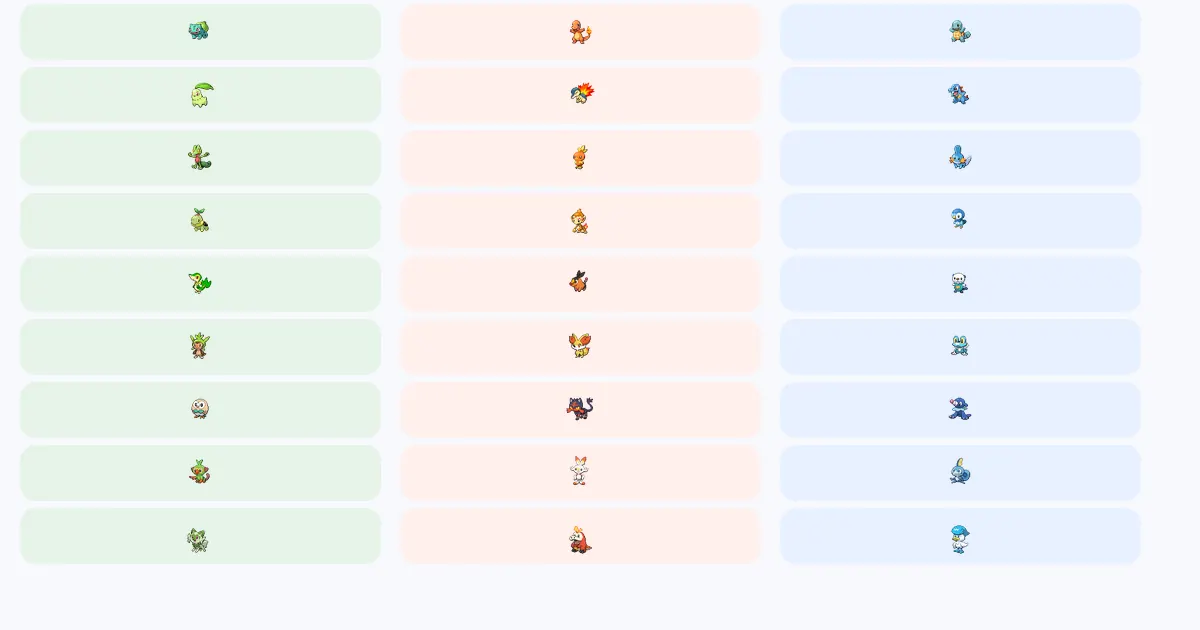
All Pokemon Starters by Generation
The table uses the familiar first-stage starter trio for each released generation. “Grass,” “Fire,” and “Water” describe the starter family at the first stage, while the final-evolution column shows where the line ends. A second type may appear during evolution, so the first-stage family is not the same thing as a complete battle role.
| Generation | Region | Grass starter | Fire starter | Water starter | Final evolutions |
|---|---|---|---|---|---|
| Gen 1 | Kanto | Bulbasaur Grass / Poison line | Charmander Fire line | Squirtle Water line | Venusaur, Charizard, Blastoise |
| Gen 2 | Johto | Chikorita Grass line | Cyndaquil Fire line | Totodile Water line | Meganium, Typhlosion, Feraligatr |
| Gen 3 | Hoenn | Treecko Grass line | Torchic Fire line | Mudkip Water / Ground line | Sceptile, Blaziken, Swampert |
| Gen 4 | Sinnoh | Turtwig Grass line | Chimchar Fire / Fighting line | Piplup Water / Steel line | Torterra, Infernape, Empoleon |
| Gen 5 | Unova | Snivy Grass line | Tepig Fire / Fighting line | Oshawott Water line | Serperior, Emboar, Samurott |
| Gen 6 | Kalos | Chespin Grass / Fighting line | Fennekin Fire / Psychic line | Froakie Water / Dark line | Chesnaught, Delphox, Greninja |
| Gen 7 | Alola | Rowlet Grass / Flying line | Litten Fire / Dark line | Popplio Water / Fairy line | Decidueye, Incineroar, Primarina |
| Gen 8 | Galar | Grookey Grass line | Scorbunny Fire line | Sobble Water line | Rillaboom, Cinderace, Inteleon |
| Gen 9 | Paldea | Sprigatito Grass / Dark line | Fuecoco Fire / Ghost line | Quaxly Water / Fighting line | Meowscarada, Skeledirge, Quaquaval |
Counting rule: This is the standard main-series starter list, not a complete catalog of every Pokemon that can be received at the beginning of every game. Partner Pokemon, regional variants, spin-off starters, and special distributions are discussed separately so the core Gen 1-9 table stays consistent.
Why the Starter Trio Uses Grass, Fire, and Water
The three-way Grass, Fire, and Water pattern gives a new player an easy first decision while also creating a simple type relationship: Grass is strong against Water, Water is strong against Fire, and Fire is strong against Grass. The relationship is not the whole battle system, but it makes the opening choice understandable before a player learns abilities, dual types, moves, and status effects.
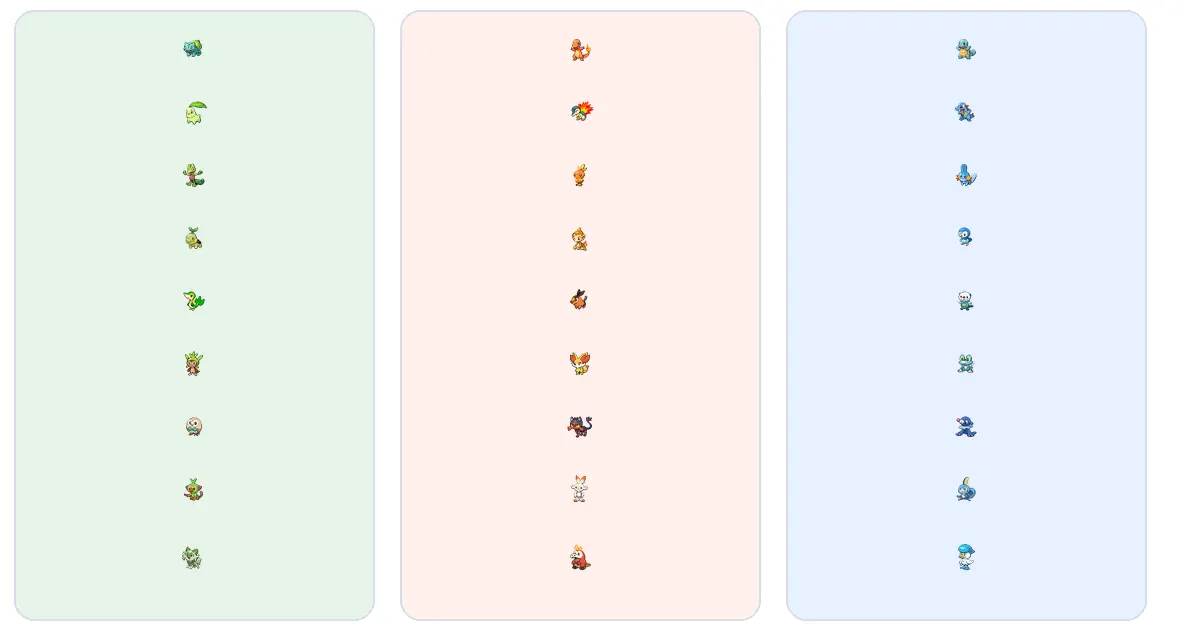
The pattern becomes more interesting after the first stage. Some lines stay single-typed, while others gain a second type that changes their resistances, weaknesses, speed profile, or role. That is why a starter choice can feel different at the end of a playthrough even when the opening labels are always Grass, Fire, and Water.
Starter Evolution Lines and Final Types
Starter Pokemon are usually presented as three-stage evolution families, and comparing the final forms is often more useful than comparing only the first-stage designs. Charizard and Blaziken, for example, turn a Fire starter into different offensive identities. Swampert, Empoleon, Greninja, Primarina, and Skeledirge show how Water or Fire lines can gain a second type that changes the way they fit a team.
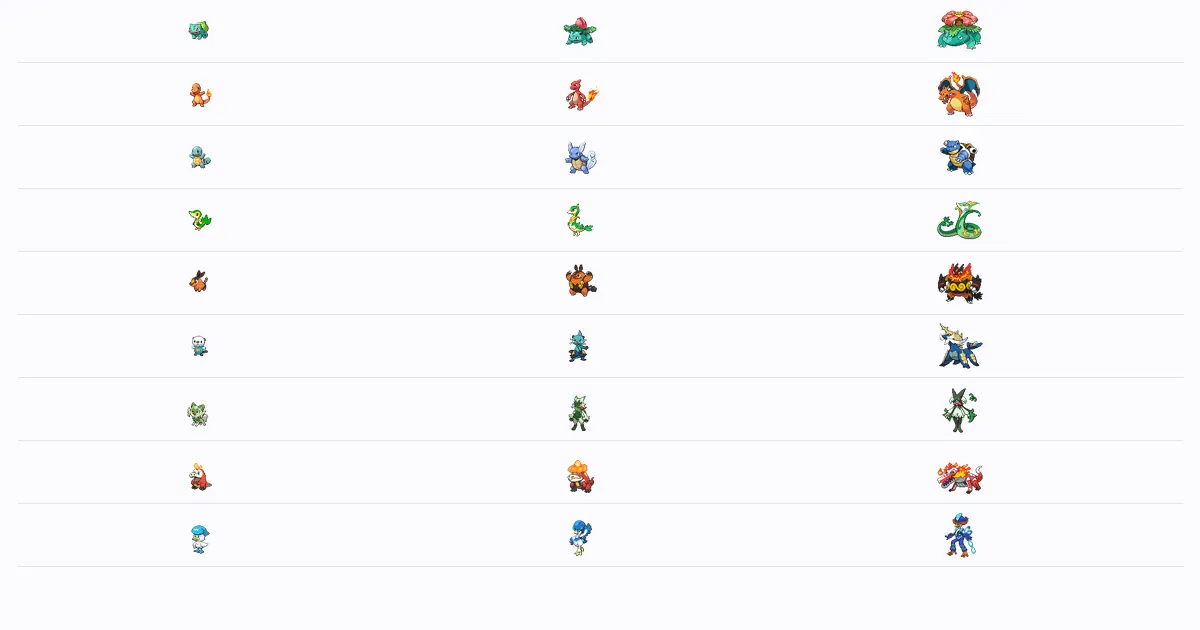
Choose by first-stage design or final evolution?
There is no correct rule. Choose by the first-stage design when the early-game companion matters most, by the final evolution when you care about the finished team, or by the complete line when you want the choice to feel consistent from the opening route to the endgame. A reference list helps you compare the options without turning a personal preference into a claim about competitive strength.
Why type labels need a caveat
The table labels the family at the first stage and calls out common final-line changes. It does not replace a full matchup chart: abilities, moves, held items, regional forms, game rules, and team context can matter more than the starter's original type. Use the site's Pokemon Weakness Calculator if the next question is about team coverage rather than starter preference.
A quick way to compare starter generations
Start with the region row that matters to you, then compare the three first-stage designs before looking at final forms. If you are choosing for a replay, check whether you prefer a single-type line or a line that gains a second type. If you are making a personal favorites list, keep design, memories, and playthrough stories separate from competitive rankings. That small rule keeps the comparison useful: a starter can be your favorite because of its character or evolution design even when another line is stronger in a particular battle format.
Partner and Special Starter Choices
Pikachu and Eevee are the clearest example of why “all starter Pokemon” can mean different things. In Pokemon Let's Go, Pikachu! and Pokemon Let's Go, Eevee!, the partner is central to the adventure, but those choices are not extra members of the normal Kanto Grass, Fire, Water trio. They are best labeled as partner starters or special starter-style choices.
Other games and spin-offs can also give players unusual early partners, regional variants, or different starter rules. Those choices are worth mentioning when a page is about a specific game, but mixing them into the standard generation table makes it harder to answer the basic search question. This guide therefore keeps the core list stable and sends game-specific decisions to the relevant tool or source.
Starter List vs Starter Picker
A starter Pokemon list is best when you want to scan all generations, check a name, compare final forms, or settle a debate about which region introduced a starter. The site's Starter Pokemon Picker is better when you already want to choose: filter the released pool by generation or family, save one choice per generation, randomize a result, and export the list.
Use this reference
Compare every Gen 1-9 trio, check Grass/Fire/Water families, review final evolutions, and understand special partner exceptions.
Use the picker
Filter, select, randomize, save, and export a personal starter list without browsing the full Pokedex.
Use the generations guide
Read release years, regions, main games, species counts, and the distinction between a released generation and an announced future era.
Use the main picker
Choose favorite Pokemon across many generation and type cells when the task is broader than starters.
If you are comparing starter preferences with a larger personal ranking, the Top 100 Favorite Pokemon Picker is a better destination than forcing starter choices into a strict tier list. Keeping these page jobs separate makes the site easier to navigate and avoids treating a reference table, a picker, and a ranking tool as the same intent.
Pokemon Starters by Generation FAQ
How many starter Pokemon are there in each generation?
The standard pattern is three first-stage starters per released generation: one Grass, one Fire, and one Water Pokemon. Gen 1 through Gen 9 therefore contain 27 standard first-stage starters.
Are Pikachu and Eevee part of the normal starter trios?
No. Pikachu and Eevee are special partner choices in the Let's Go format. They are starter-style partners, but they do not replace or expand the standard Kanto trio in this reference table.
Which generation has the most starter Pokemon?
Every released generation in the standard list has the same three first-stage choices. A game may add partner or special choices, but those should be counted separately from the normal regional trio.
Do all starter Pokemon keep one type forever?
No. Many final evolutions gain a second type. The original Grass, Fire, or Water label is a useful starting category, not a guarantee about the final form's complete matchup profile.
What is the difference between a starter list and a starter picker?
The list is for research and comparison. The picker is for an action: filter the pool, choose or randomize a starter, save one per generation, and export the result.
Where can I choose one starter from every generation?
Open the Starter Pokemon Picker to save one released starter choice per generation. For broader favorites by type and generation, use the Favorite Pokemon Picker.
Summary
The standard Pokemon starters by generation pattern is simple: Gen 1 through Gen 9 each introduce a Grass, Fire, and Water trio, producing 27 first-stage starters in the core reference list. The interesting differences appear in region identity, design, evolution lines, and the secondary types many final forms gain. Use this page to compare the full list, then switch to the Starter Pokemon Picker when you are ready to choose and save your own favorites.
Sources and verification
- The Pokemon Company: Pokemon Presents recap — official franchise context for the current release roadmap.
- Bulbapedia: First partner Pokemon — community reference for the standard starter and partner terminology.
- Pokemon Database National Pokedex — community cross-check for names, types, and evolution lines.