Pokemon Evolution Chart: Evolution Lines, Methods, and Branching Examples
This Pokemon evolution chart explains how an evolution line moves from a starting species to a later form. It groups representative lines by level-up, item, trade, friendship, time, and special-action conditions, then shows why some families branch into different results. Use the table for a quick lookup and the method sections when the trigger is more important than the name.
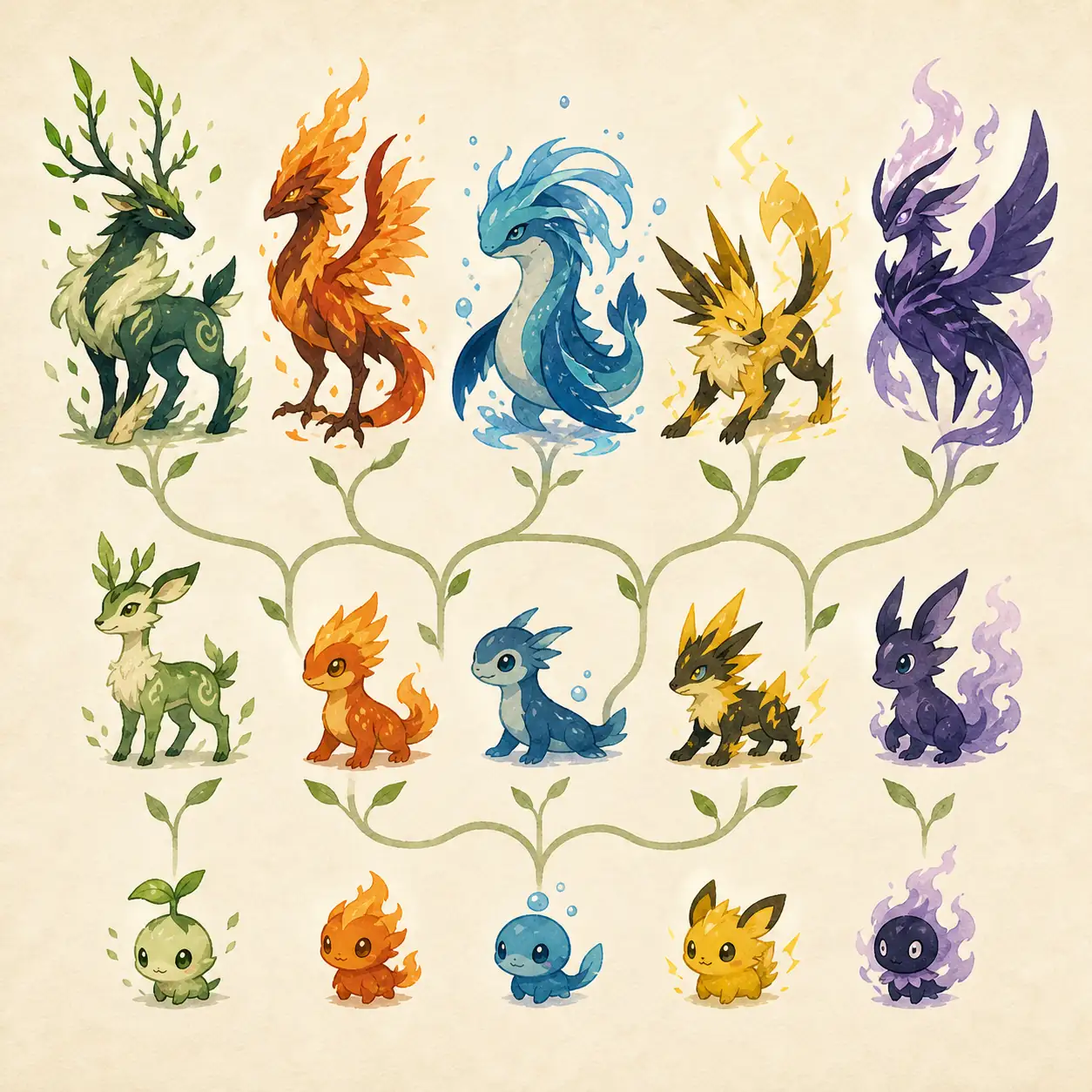
Pokemon Evolution Chart at a Glance
The table is organized around the decision a reader usually needs to make: what line is this, what usually triggers the next step, and where can the line branch? Level numbers are included when they are stable and widely used, while game-specific conditions are described with a caution instead of pretending that one rule works in every title.
| Evolution line | Typical method | Trigger or example | What to watch for |
|---|---|---|---|
| Bulbasaur → Ivysaur → Venusaur | Level-up | Ivysaur at level 16; Venusaur at level 32 in the classic main-series pattern. | A straightforward three-stage line with no normal branch. |
| Charmander → Charmeleon → Charizard | Level-up | Charmeleon at level 16; Charizard at level 36 in the classic main-series pattern. | Mega Evolution and Gigantamax are forms, not ordinary evolution stages. |
| Magikarp → Gyarados | Level-up | Magikarp evolves at level 20 in the standard main-series rule. | A simple line that is often used as the clearest evolution example. |
| Pawmi → Pawmo → Pawmot | Special action | Pawmo needs a walking step condition before leveling up. | Walking requirements are easy to miss if you only check the level number. |
| Gimmighoul → Gholdengo | Special action | Collecting coins is part of the evolution requirement before the level-up. | Some newer lines use a collection target rather than a simple level. |
| Eevee → Vaporeon / Jolteon / Flareon | Evolution stone | Use a Water Stone, Thunder Stone, or Fire Stone. | This is only part of the Eevee family; other branches use friendship, time, or newer stones. |
| Ralts → Kirlia → Gardevoir / Gallade | Level + item branch | Kirlia levels into Gardevoir normally; a qualifying Kirlia can use a Dawn Stone for Gallade. | Branch eligibility can depend on the species, gender, and game rules. |
| Tyrogue → Hitmonlee / Hitmonchan / Hitmontop | Stat branch | Tyrogue checks its stat relationship when it reaches the evolution level. | The target is not chosen from a menu; the stat comparison decides the branch. |
| Wurmple → Silcoon / Cascoon | Hidden branch | The line branches according to an internal value rather than a player-selected item. | Two players can raise Wurmple in the same way and still see different results. |
| Sneasel → Weavile | Item + time | A Razor Claw and a time-of-day rule are used in many main-series contexts. | Some games use a different item or a different Sneasel form. |
| Scyther → Scizor / Kleavor | Trade or item | Scizor is associated with a held-item trade; Kleavor uses a different item in its game context. | One species can have separate evolution destinations in different games. |
| Porygon → Porygon2 → Porygon-Z | Trade + items | Upgrade and Dubious Disc are used across two trade-based steps. | Item possession and the trade action both matter. |
| Golbat → Crobat | Friendship | Raise friendship, then level up. | Friendship is not the same as affection, happiness hearts, or battle level. |
| Riolu → Lucario | Friendship + time | High friendship followed by a daytime level-up in the common main-series rule. | Night/day checks and regional game rules can change the result. |
| Eevee → Espeon / Umbreon / Sylveon | Friendship branch | Time of day or a Fairy-type move requirement separates several branches. | Move knowledge, friendship, and time can interact; check the exact game. |
| Slowpoke → Slowbro / Slowking | Level or trade | Slowbro follows a level-based path; Slowking is associated with a King's Rock trade. | Regional Slowpoke lines can add a separate form-specific rule. |
| Feebas → Milotic | Game-dependent | Older games may use Beauty; later contexts can use a Prism Scale trade. | This is a good example of why the title of the game matters. |
| Inkay → Malamar | Special action | Leveling while the system is held upside down is the well-known trigger. | It is memorable, but not a universal rule for other games or platforms. |
| Nincada → Ninjask + Shedinja | Extra result | Leveling Nincada can create a second result when party and Ball-space conditions are met. | The main line and the bonus result are easy to confuse in a simple list. |
| Charcadet → Armarouge / Ceruledge | Held item branch | Different armor items determine the destination. | The branch is version-sensitive, so a single “best” answer is misleading. |
| Applin → Flapple / Appletun / Dipplin | Item branch | Apple items select different destinations; later content adds another branch. | Newer DLC or updated game content can extend an older evolution tree. |
Scope note: This is a practical Pokemon evolution chart, not a complete species-by-species National Pokedex dump. It prioritizes the patterns that help readers understand a line quickly. For an exhaustive lookup, use a full Pokedex database and confirm the game version, regional form, and platform before acting on a trigger.
How to Read a Pokemon Evolution Chart
A useful evolution chart should answer three separate questions instead of hiding them in one long arrow. First, what species starts the line? Second, what condition causes the next change? Third, does the line split, merge, or create an extra result? Keeping those questions separate prevents a common mistake: reading a final form as if it were the only possible destination.
1. Start with the base species
Search by the species you currently have, not only by the form you want. If you want a Gardevoir, for example, start with Ralts and check the line through Kirlia. If you want a Gholdengo, start with Gimmighoul and read the special collection requirement. This approach is faster than searching only for an isolated final name.
2. Read the trigger as a full condition
“Level up” is often incomplete. A line may need a particular level, time of day, move, friendship threshold, location, held item, party condition, or multiplayer state. The trigger column should therefore be read as a short rule, not as a decorative label. When a chart says “friendship + time,” both parts matter.
3. Separate evolution from forms
Mega Evolution, Gigantamax, Terastallization, regional forms, costumes, and battle transformations are not automatically new evolution stages. A chart that mixes every form into one chain becomes hard to use and can inflate the number of species. For generation context and National Pokedex counting rules, compare the site's Pokemon Generations List.
The Main Pokemon Evolution Methods
Across the franchise, most evolution conditions fit into a small number of families. The names and exact thresholds can change, but the decision pattern stays recognizable. Use these cards as a fast mental model before opening a game-specific entry.
Level-up evolutions
These are the simplest lines: reach a level and the next form becomes available. Bulbasaur, Charmander, and Magikarp are useful reference examples. Level-up does not always mean “the next level”; some lines add a move, time, location, or other condition.
Stones and other items
Evolution stones make branching lines easy to recognize, especially Eevee. Other families use armor, apples, discs, scales, or held items. The item itself can decide the destination, so using the wrong item can create a different branch or do nothing.
Trade and held-item trades
Kadabra, Machoke, Haunter, and Graveler are familiar trade examples. Porygon and some other lines add a held item to the trade. When a chart says “trade,” check whether the item must be held before the exchange begins.
Friendship, time, and special actions
Friendship lines may depend on daytime or nighttime. Other lines use walking, a move, a location, multiplayer, a battle action, or even an upside-down system. These conditions create the biggest gap between a general chart and a game-specific guide.
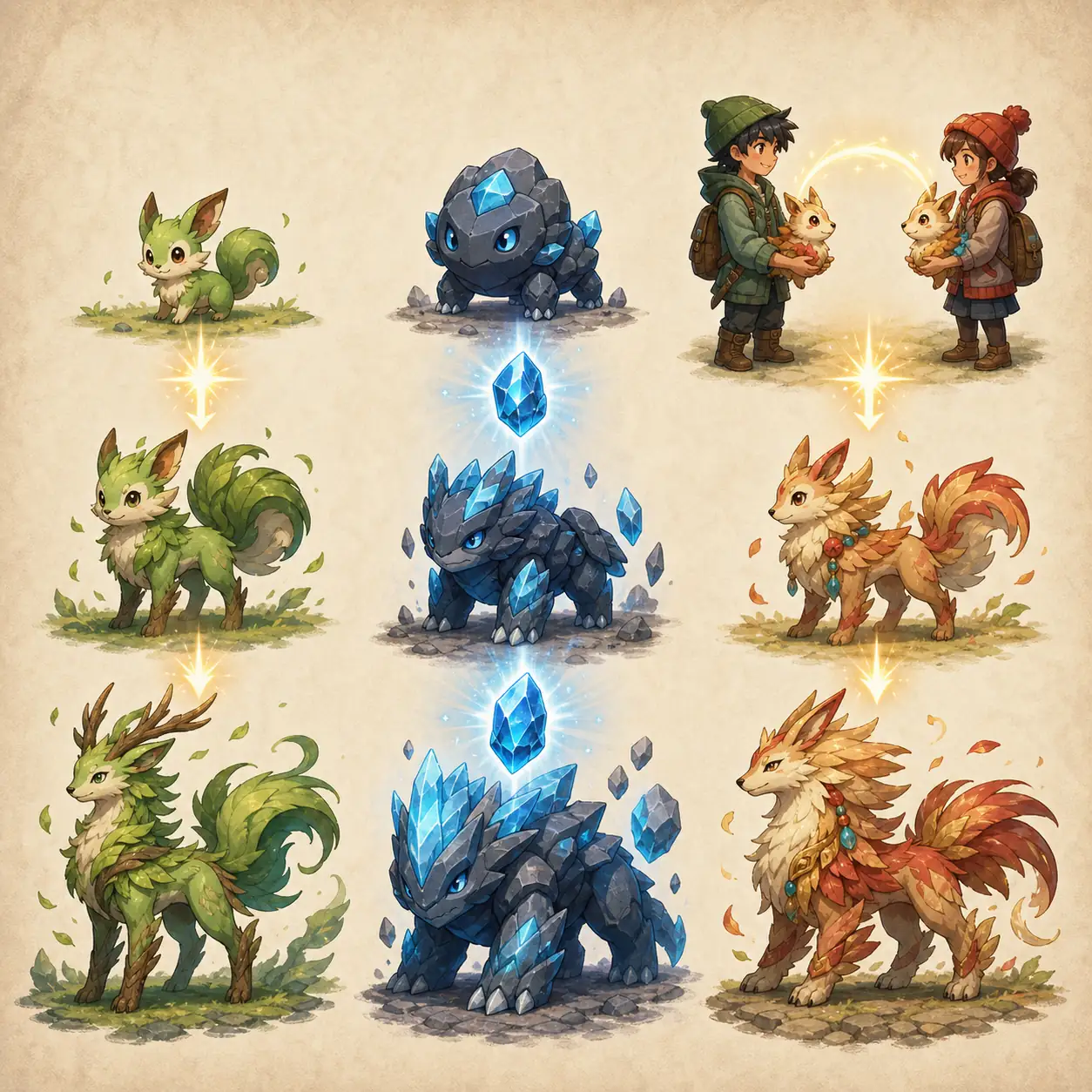
Branching Evolution Examples
Branching lines are where a basic list turns into an actual evolution tree. The correct destination may depend on an item, gender, stat comparison, friendship, time, hidden value, version, or the game itself. These examples show why the condition should sit next to the arrow in any readable chart.
Eevee: item and friendship branches
Eevee can reach Vaporeon, Jolteon, or Flareon with elemental stones. Other paths lead to Espeon, Umbreon, or Sylveon through combinations of friendship, time, and move requirements. Later games may add additional stone-based branches, so the exact game is part of the question.
Ralts: a gender-gated branch
Ralts → Kirlia is a normal level-up line. From Kirlia, Gardevoir is the standard destination, while a qualifying male Kirlia can use a Dawn Stone to reach Gallade. A chart should show both the normal line and the item branch.
Tyrogue: a stat comparison
Tyrogue can become Hitmonlee, Hitmonchan, or Hitmontop. The destination is determined by the relationship between its stats when the evolution check occurs. It is a branch that cannot be represented accurately by “use this stone.”
Wurmple: a hidden-value branch
Wurmple can lead to Silcoon or Cascoon without a player choosing a visible item. The internal value means that two apparently identical playthroughs can produce different results. This is why “random-looking” branches need a note instead of a missing trigger.
Applin: an item-selected tree
Applin uses apple items to reach different forms, with later game content adding another branch. The family is a good reminder that an evolution chart can grow when a new title or expansion introduces another item and destination.
Charcadet: version-sensitive armor
Charcadet uses different armor items for Armarouge and Ceruledge. The line is not a simple “level until it changes” family; the version or item available to the player determines the final branch.
Why Evolution Methods Vary by Game
The same species can appear in several generations, remakes, regional forms, and spin-offs without keeping one universal trigger. A classic trade evolution may become an item evolution in a later game. A line that once needed a location may use a stone instead. A regional form may have a separate chain from its original counterpart. These differences are not errors in a chart; they are a sign that the chart needs a game column or a clear scope note.
For a safe lookup, record the game first, then the species, then the form. Next check whether the line is a standard species, a regional variant, a special partner, or a battle form. Finally verify whether the trigger requires another player, a specific time, an item, a move, a location, or a party condition. This sequence reduces the chance of following a correct rule from the wrong title.
If your goal is choosing favorites rather than completing a Pokédex, the evolution line is also a useful comparison tool. The Pokemon Starters by Generation guide keeps the nine standard starter trios separate, while the Pokemon Picker Chart Guide helps you turn a personal preference into a shareable generation-by-type chart.
Pokemon Evolution Chart FAQ
What is a Pokemon evolution chart?
A Pokemon evolution chart maps a starting species to later forms and places the trigger beside each arrow. The trigger can be a level, item, trade, friendship, time, location, move, walking requirement, or another game-specific action.
What are the main Pokemon evolution methods?
The main groups are level-up, evolution stone or other item, trade, friendship or time of day, and special actions. Some lines combine two groups, such as a trade that requires a held item or a friendship level-up that also checks the time.
Why do some Pokemon have more than one evolution?
Branching conditions let one starting species reach different destinations. Eevee uses several item and friendship routes, while Ralts, Tyrogue, Wurmple, Applin, and Charcadet use different combinations of eligibility, stats, hidden values, items, or game versions.
Does a Pokemon evolution method change between games?
Yes. The species and final form may stay the same while the trigger changes in a remake, regional game, or spin-off. Confirm the exact title, form, and version before treating a general chart as a step-by-step solution.
Is this a complete National Pokedex evolution list?
No. This page is a practical reference for common lines, methods, and branch patterns. It is intentionally easier to scan than a full species-by-species database, and it points you toward external Pokedex references when you need an exhaustive lookup.
Summary
The most useful way to read a Pokemon evolution chart is to keep the three parts visible: starting species, trigger, and result. Level-ups explain many classic three-stage families, while items, trades, friendship, time, hidden values, walking, multiplayer, and special actions explain the lines that do not fit a simple level table. When a branch or regional form is involved, add the game and version before choosing an item or planning a trade.
Sources and verification
- The Pokemon Company National Pokedex — official species and form reference for cross-checking names.
- Bulbapedia: Evolution — community reference for evolution mechanics, conditions, and game-specific exceptions.
- Pokemon Database evolution chains — community cross-check for representative evolution lines and branches.